

Growing Disciples: Book by Book is a series of brief, practical reviews of children’s ministry and child‑theology books. Each article gives you a clear summary, theological reflection, and 2–3 ideas to consider in your context. If you have suggestions of what books I could review next, leave a comment at the end of the article. If you find that these reviews contribute to the health of your ministry, please consider contributing to this series by becoming a paid subscriber.
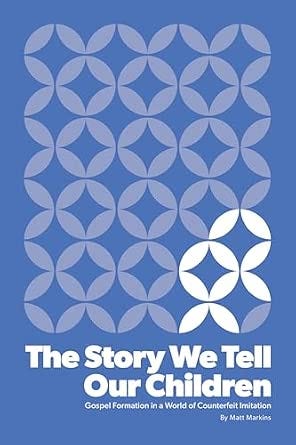
Title: The Story We Tell Our Children: Gospel Formation in a World of Counterfeit Imitation
Author: Matt Markins
Published: Awana, 2025
Disclaimer: This book was sent to me at no cost by the publisher. There was no requirement to review it or to endorse it; what follows is my honest assessment.
As I consider the future of children’s ministry and childhood faith formation, I keep returning to the idea of helping the next generation become confident Christians in a post-Christian world. Regular readers or listeners to The Shock Absorber podcast will know that I’m not an anxious culture warrior. I’m not persuaded by either the “take back Christendom” or “retreat from the world” postures. (Though performing in either of those positions would likely grow my audience ten-fold!) Instead, I think about how to foster a robust, albeit non-anxious faith, in young people.1
Therefore, I was delighted to read Matt Markins’ The Story We Tell Our Children: Gospel Formation in a World of Counterfeit Imitation. I always look forward to the research that Markins and the team at Awana provide on children’s ministry, and I have previously interviewed him about the prior publication, The Faith of Our Children.
The Story We Tell Our Children provides a clear diagnosis of the challenges facing Christian families and churches in an increasingly post-Christian age, and gives a largely persuasive and mostly non-anxious antidote to the counterfeit stories of the secular West (qualifiers that I will discuss below in more detail).
The Big Idea
The big idea of the book is the importance of storying our children and the role of narrative formation.
Here’s one key quote that summarises the heart of the book:
“Stories form children at a very young age.
Childhood stories form lifelong identity (i.e. shape lifelong worldview).
If childhood stories happen to be counterfeit stories, they can form a counterfeit identity by early adolescence.” (p.4)
Key Arguments
This book is short, coming in at under 80 pages. So instead of going chapter by chapter, I’ll highlight the two key arguments that Markins makes along the way.
The False Narratives
Markins rightly notes the increasingly post-Christian culture in the West.
“Digital capitalism, hedonism, post-Christian thinking, the sexual revolution, Moralistic Therapeutic Deism, the “scientific is the final authority” narrative — each of these movements is a powerful force at work. And these pervasive forces are telling today’s children a humanistic story using the distribution systems of the entertainment industry, social media, professional sports and academics. Kids in Christian homes, kids in non-Christian homes — to some degree, every child is swimming in the dominant, mainstream narratives, no matter how much we try to shelter and protect them.” (p.22)
While this may be startling news for some USA readers, for those of us in the non-American West, this is not a new story. Secularity has grown rapidly across Europe and the Anglosphere for decades. Data from the Australian census and NCLS survey show that Christianity is a minority religion (44%)2 and only 7-8% of the population attended church monthly3. Unless your family takes an extreme “retreat” posture, we “cannot completely protect our children from the drifting smoke of the secular, non-believing world” (p.44).
However, with the all-pervasiveness of the secular story comes the realisation that the story had failed to create a satisfying narrative to live into. There are very few brave or naïve enough to claim that young people in 2026 are flourishing. The failure of the counter-formation of the culture can be used to the wise parent and minister’s advantage.
“We need to clearly point out the cognitive dissonance of these counterfeit stories — the false gospels that capture the affections of this generation. We should age-appropriately allow children and young people to see the failures of secularism side by side with reality, which is the sufficiency and goodness of the Gospel.” (p.44)
The True Story
Unsurprisingly, it is the Gospel that Markins puts forward as the story we must enculturate our children into. However, it must be the full story, not the truncated version—you’re a sinner in need of a saviour—that populates many “gospel presentations”. This is true, but only two parts of a four-part story. As Markins writes:
“When we condense the Gospel down to only the fall (part 2 — you’re a sinner) and redemption (part 3 — only Jesus can save you), we cheapen the fullness of the Bible and God’s story to us. When we leave out the creation narrative (part 1), we omit the genesis of where a child’s true identity comes from—Christ! And when we leave out restoration (part 4), we undermine the message that God can restore, heal and transform a child who walks with Him and His disciples for a lifetime—and one day He will make all things new. How could we omit this amazing hope for the future?!” (p.67)
I appreciate Markins emphasis on the whole story of the Gospel. The Bible does not start at Genesis 3 and conclude with Jesus’ atoning death and resurrection. Beginning the story at “very good, God-image-bearing creation”, rather than “miserable sinners”, is no minor reframing. It does not undermine the depth of our sin (in fact, it highlights the height from which we have fallen), but it allows children to see that, despite sin, they are deeply loved members of God’s good creation, and there is much to notice and celebrate about who God has made (not just remade) them to be.

Nit-Picky
I mentioned above that the book is largely persuasive and mostly non-anxious. Let me offer one very minor and then one more meaningful critique.
Counterfeit Capture
Markins open the book with a lengthy description and origin of the term “Stockholm Syndrome”. The point with regard to his argument is this:
“The stories children believe about themselves and the world around them can become so captivating that they can develop a deep affection for a counterfeit captor… these counterfeit stories can sometimes hold them hostage for a lifetime.” (p.5)
The analogy fits, and yet it unsettles me. Equating the narrative formation of the secular world as Stockholm Syndrome, not only raises the anxiety levels of the reader, but makes it difficult to imagine transformation into the likeness of Christ.
Research from Barna and Awana have consistently advocated for the importance of early worldview formation. However, the power of the Gospel is capable of transforming us, through the renewing of our minds, to “be able to test and approve what God’s will is – his good, pleasing and perfect will” (Romans 12:2). There is hope for the child, young person, or adult who has—until the moment of conversion—thoroughly been formed by the counterfeit story. While a powerful metaphor and a strong motivator for taking faith formation seriously, I would caution against language that implied that a child immersed in the post-Christian world is a “hostage for a lifetime.”
Holistic Gospel Formation
I heartily agree with the necessity of re-storying our children with the Gospel message.
“When we have clarity around the Gospel narrative, and also have consistent Scripture engagement, we are giving [children] the best opportunity to form lasting faith.” (p.54)
Amen and amen!
My one critical reflection on Markins argument is that this Gospel re-storying happens, almost exclusively, through cognitive and didactic means. Consider the following:
“The child who grasps the fullness of the Gospel narrative — creation, fall, redemption and restoration — has full Biblical context … this child views the Bible as a reality superstructure which all of the Bible stories and virtues can fasten to.” (p.54)
Note the necessary cognitive development and comprehension required to fulfil this task. I believe in teaching and use catechism, memory verses, and comprehension tasks regularly in my ministry. However, virtue, character and worldview formation does not occur only through cognitive means.
I would love to see Markins take his argument further and explore how elements such as imaginative play, craft and games, the practice of habits, religious socialisation and other holistic elements of a child’s experience of the world complement the cognitive aspect of narrative formation. Knowing the story is essential, but insufficient to fully “grasp the fullness of the Gospel narrative.”
Conclusion
A brief, but important book, The Story We Tell Our Children is a powerful argument for the narrative formation of our children according to the Gospel story. We cannot retreat from the post-Christian world, but we can intentionally engage in Christian counter-formation so that our children and young people have “the best opportunity to form lasting faith.”
Thanks for reading this instalment of Growing Disciples: Book by Book. If you have suggestions for future books worth reviewing, please leave a comment below.
For a non-children’s ministry book that takes this approach, I recommend David Rietveld’s Being Christian After Christendom.
https://www.abs.gov.au/media-centre/media-releases/2021-census-shows-changes-australias-religious-diversity
https://www.ncls.org.au/articles/changes-in-church-attendance-in-australia/
I enjoyed your review. I have been advocating storytelling (telling God's stories well in chronological and contemplative ways) for young children for a long time. We're not teaching algebra, we're teaching God's Word, the story of his rescue mission for his people. We need to give children time to reflect and process in beautiful ways, to wonder, create, imagine, and question. Cynthia Fischer, author of a reformed, worship-based curriculum, The-Childrens-Sanctuary.com.