

In 1984, British Evangelical preacher, pastor, and author John Stott published the first edition of Issues Facing Christians Today (later updated and republished through to the 4th edition in 2006). I discovered Stott’s book in the late 90s while still in high school, and it has become one of the most transformative books I have ever read.
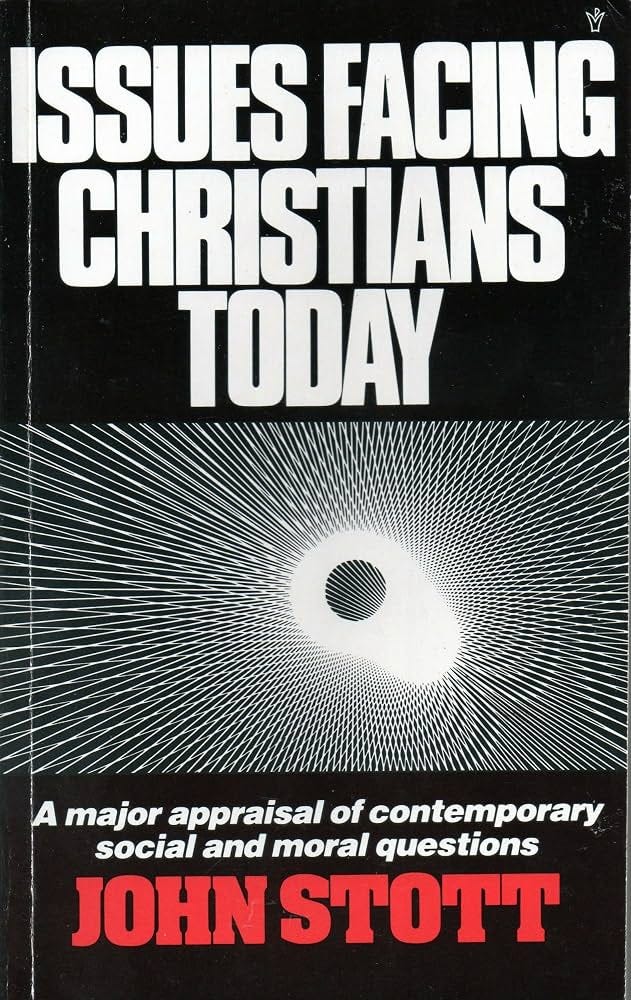
As I explain on this week’s episode of The Shock Absorber podcast, it was Stott’s refusal to conform to the ‘Gospel vs. Social Gospel’ divide that was most compelling. I was not yet cognisant of the larger cultural context of 1980-1990s evangelicalism that had shaped my early church experience. The Fundamentalist–modernist controversy of the early 20th Century had morphed into a conservative-progressive divide, with the former prioritising Gospel proclamation, repentance and personal faith, and the latter emphasising the social needs of the poor, downcast and destitute.
Growing up in the conservative Christianity of Sydney Anglicanism, I had imbibed the notion that “real” Christians care about people’s salvation, and the derisive term “social gospel” was used for those progressives who didn’t hold a high view of Scripture, Jesus and the atonement.
[[Of course the truth is far more complex. There are certainly examples of Christian organisations that lost their way by emphasising social needs at the expense of explicit Christian distinctives (e.g. the YMCA, Young Men’s Christian Association). However, even within my own conservative church context, there were and continue to be diocesan-level programs like Anglicare and Anglican Aid that engage in explicit practical needs ministry to vulnerable people locally and globally.]]
John Stott was revered in the Sydney evangelical world. A regular visitor to our shores, his expositional approach to preaching, alongside his clarity and warmth, and his editorial oversight of—and significant contributor to—The Bible Speaks Today commentary series made him the closest we had to a living saint (at least the closest that evangelical Protestants are allowed to have).
That this same John Stott had written a book about ‘social issues’ spanned the unbridgeable chasm in my evangelical imagination between those who took the Bible seriously and those who took societal concerns seriously. Stott never loses his commitment to conservative, evangelical hermeneutics, and yet insightfully applies the Scriptures to modern-day concerns that were (I believed) the domain of “social gospel” types like nuclear war and industrial relations, as well as those social issues that evangelicals were allowed to talk about, such as sexuality and abortion.
Through Stott, I was brought back to an earlier world of evangelicalism; one that could hold the authority of Scripture alongside the genuine care for people, systems, and creation. This was the evangelical world that fostered Sunday Schools as education and moral formation, the abolition of slavery, women’s suffrage, child labour laws, and the RSPCA.
The issues of 2026 are not those of Stott’s 1980’s, much less those of the Clapham Sect, Hannah More or Robert Raikes. But these evangelicals provide a model for engagement with social concerns that refuses to compromise on biblical authority. In fact, it is the authority of Scripture that drove these evangelicals to care for vulnerable people, species and creation.
Catch the full conversation in the links below, where the conversation between Joel McMaster, Stuart Crawshaw and I also covers:
The Jesus Revolution of the 60-70s
How charismatic preacher Winkie Pratney prompted Stu to leave his PhD program
Why Shaun the Sheep and incarnate church community are the answers that an AI-slop-world is looking for
On the NSW Teacher’s Strike - From the Archives
Back in 2022, teachers in NSW went on strike around issues of workload and pay structures. As a proud husband of a public school teacher, I wrote this piece in support of the strike, riffing off Stott’s chapter on industrial relations.
John Stott, the late English author/preacher/theologian quotes Archbishop of Canterbury William Temple in his chapter on industrial relations in ‘Issues Facing Christians Today’:
“The worst horrors of the early factories have been abolished, but the wage earners are not yet fully recognised as persons, for… the “workers” usually have no voice in the control of the industry whose requirements determine so large a part of their lives… Every citizen should have a voice in the conduct of the business or industry which is carried on by means of his labour.”
I know first hand the labour of public school teachers. I see the 55+ hours per week and all of the preparation, planning, marking, and administration that happens outside of the 6 hours per day of upfront teaching and playground duties (with only an allowance for a 30min break in a 6.5 hour school day).
I see the passion for shaping the lives of young children and hear the joy in the stories of concepts grasped, skills acquired, friendships forged and the delight of learning. I sit with the exhaustion and the frustration of administrative overload and unreasonable parental expectations and the wondering if it really is worth it after all.
I see the cost of resources that are purchased out of teacher’s own pockets because schools are underfunded but they want to give their students the most engaging learning. I feel the anger of another thoughtless comment of “teachers only work 40 weeks a year” or that “they’ve just had 5 months off, what more do they want”; comments made, not having seen that in the last 5 months those 55+ hours per week crept up to 65-70+ as teachers who are experts at incarnate, in-class learning, had to adjust once again to online delivery and digital tools whilst attempting to serve their students as best as they were able.
Stott consolidates Temple’s argument by saying:
“Christians will agree that at the very least there should be a procedure of consultation, and, more important, that this should not be a piece of window-dressing but a genuine discussion early in the planning process which is reflected in the final decision.”
Our teachers have been consulted (cf. Gallop report) and they have consistently reported that they are overworked, overburdened with administration, under-resourced, underpaid in comparison with other 4-year-degree professions, and at high risk of burnout and leaving the profession that they love.
Yes, I am selfishly invested. Many of those closest to me are teachers who I care for deeply. But I am also invested in good public schooling (and health, transport, etc.) for the good that it brings to all children and households in our State.
This is not THE definitive political position, far less a definitive Christian position. There will be other good positions one can take. But for what it’s worth, this is why #Istandwithteachers and believe they deserve #MoreThanThanks.