

“Growing Disciples: Book by Book” is a new series of brief, practical reviews of children’s ministry and child‑theology books. Each article gives you a clear summary, theological reflection, and 2–3 ideas to consider in your context. If you’ve got suggestions of what books I could review next, leave a comment at the end of the article. If you find these reviews contribute to the health of your ministry, please consider contributing to this series by becoming a paid subscriber.
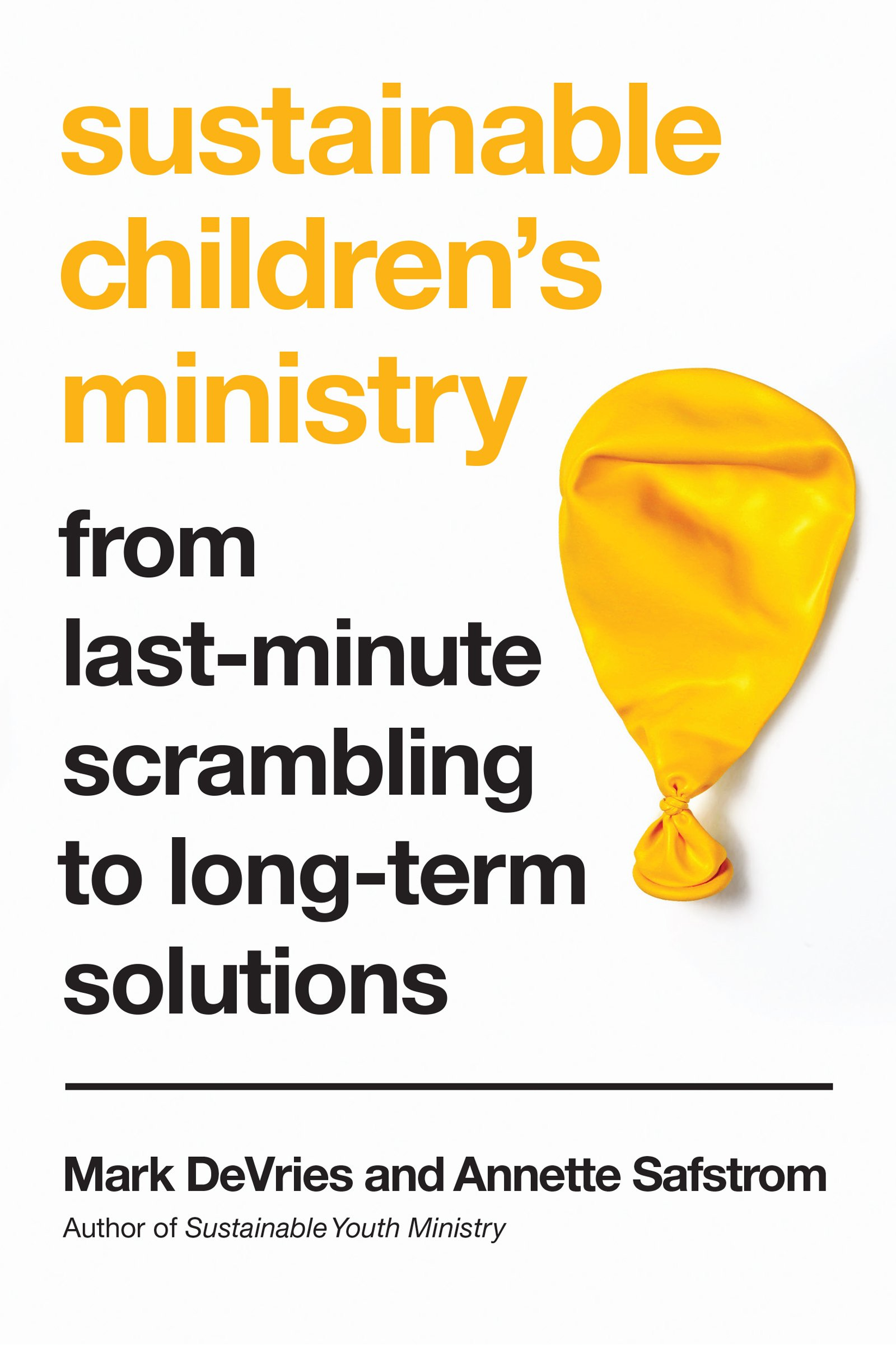
Title: Sustainable Children’s Ministry: From Last-Minute Scrambling to Long-Term Solutions
Author: Mark DeVries & Annette Safstrom
Published: IVP, 2018
Welcome to the first review in this new series, where I read through Children’s Ministry books and tell you what I think. Together, we’ll explore the theology, strategy and practice of children’s, family, and intergenerational ministry through the extensive literature in each of these fields, not to mention all the sub-disciplines and adjacent conversations like developmental studies, child spirituality, Christian education, and anything else that piques my interest.
I thought that I would kick off with one of my favourite children’s ministry books, Mark De Vries and Annette Safstrom’s, Sustainable Children’s Ministry. Thinking in terms of our theology, strategy, and practice paradigm, this book is firmly in the strategy leading to practice camp. There are few theological commitments, next to no Bible references, and no intentional exegesis.
What makes Sustainable Children’s Ministry special is its clear self-understanding as a strategy book with tons of practical examples, systems and handouts that Kidmin leaders can implement in their ministry straight away.
The reason that it is one of my favourite children’s ministry books is that it strengthens one of my personal weaknesses: systems that facilitate effective ministry.
If you’ve followed my writing or podcasts for some time, you’ve likely noticed my love for the theology and foundational philosophy of children’s ministry. This is my happy place. I even wrote a book about it.
When it comes to ministry practice, I’m most comfortable sitting one-on-one or with a small group of children and simply reading the Bible together and chatting about it.
Somewhere in between Kidmin theology and in-the-moment reading the Bible with kids, is my personal weak spot; building the sustainable systems that lead to long-term health of me and my ministry. Sustainable Children’s Ministry is one book I return to regularly to remind myself of the kinds of systems and structures I should be building to equip my leaders, partner with families, and champion children’s ministry in my church context.
The Big Idea
Children’s Ministry is a resource-heavy ministry. Volunteers, pastoral needs, administration, and all the accumulated craft and activity “stuff” that goes along with running a ministry for little humans. Sustainable Children’s Ministry is all about systems—what Safstrom calls “simple machines”—that enable the ministry worker to nourish rather than flounder in their role.
Here’s one key quote that summarises the heart of the book:
“Flash and fizz are fun and can be very effective at attracting young families, at least one time. But without sustainable systems beneath the unforgettable moments, the impact is almost always short lived.” (p.5)
Key Chapters
Each chapter provides a clear and concise concept that outlines the strategy of each system, and provides practical tips for implementing these simple machines into your ministry. The beauty is that each system really is simple. While the cumulative effect of putting all the ideas into practice at once would be overwhelming, each system is self-contained. This allows each of us to pick one or two we want to prioritise in the short term, and refer back to other chapters in the future.
Here are a couple of chapters and key quotes that I’ve found most helpful in my ministry:
Chapter 2 - The Workhorse Syndrome
This early chapter describes the experience of many children’s ministry leaders who move from joy in the ministry to near-burnout.
“It doesn’t take long before, a few years into our professional children’s ministry careers, the grind of expanding expectations becomes, well, a grind… Before long, our passion has subtly turned into willingness. Willingness becomes obligation. Obligation turns to chronic exhaustion, until the once-passionate children’s ministers find themselves increasingly frustrated, frayed, and defensive… They come to believe that the greatness of the need obligates them to hang in there, even though it’s been a long time since anything about the work made their hearts sing.” (pp.21-22)
I pray that this doesn’t describe you. Though I’ll admit, I’ve had some of these moments myself. However, if this is you, you will find this chapter an encouraging introduction to the more structured and systemised ministry that comes from following the tips and tricks of later chapters.
Chapter 5 - Building Your Ministry With Simple Machines
This is the first chapter that digs deep into the systems that enable sustainable ministry, focusing on the key areas of databases, calendars and recruitment. I appreciate that even in implementing systems, Safstrom’s heart is always with the child, not the system as an end to itself.
With regards to databases, Safstrom writes,
“There are few things that will affect the long-term stability of your ministry more than knowing your flock in this very deliberate way.” (p.58)
Chapter 8 - The Delegation Dance
Theologically, it is the role of the apostles, prophets, evangelists, pastors and teachers “to equip the saints for the work of ministry, for building up the body of Christ.” (Ephesians 4:11-12) Effective recruiting, training, and equipping of volunteers is essential to any sustainable children’s ministry. Therefore, it is no surprise that this topic appears in several chapters.
I appreciate this chapter on raising the vision of the ministry worker to the amplification effect of engaging others well in ministry.
“What would happen if we structured our ministry in a way that our primary job is not doing the world of ministry but equipping others to do it?” (p.98)
Chapter 12 - More Than Planning
This chapter describes the importance of working, not just in the ministry day-by-day and week-by-week, but working on the ministry. Safstrom introduces the concept of “balcony time,” intentionally stepping back from the hustle and engaging in the kind of strategic reading, thinking, and praying that will support sustainable ministry.
“In “the balcony,” you take a step back from this week’s or this month’s tasks and look at the big picture of the ministry from a higher level. This is time for you to invest in the future of the ministry by strategising, refining processes and planning for the next few months or the next year.” (p.161)
Taking time to “read our way into better children’s ministry” is one specific example of giving yourself to balcony time.
Nit-Picky
No book is perfect, not even one of my favourites. Here are a few pernickety comments to keep in mind.
Context & Theology
I’ve already acknowledged that the book is not attempting to construct a theology of children’s ministry, but that does not mean that there is not an implicit theology coming through the pages. After reflecting on some of the strategies or phrasing that struck me as strange or did not fit my context, I realised it was our definition of church that was misaligned.
While the authors do not advocate any particular denomination or theological heritage, the book feels as if it is written primarily with non-denominational evangelicalism in mind, particularly that of a seeker-sensitive flavour. While I largely agree that the strategies suggested will scale with the size of the church, the language used throughout implies a large children’s ministry with a multi-person staff team, impersonal relationships with the congregation and team members, and a high emphasis on events.
My own church context is complex. We are evangelical, but Anglican. We take our theological heritage seriously, but with a low-church expression. Even within our Diocese, our church’s strategic distinctives emphasise a small-church community and intergenerationality. For us, the gathering of God’s people around God’s word is the focal point, from which extends our commitment to preaching, sacraments, discipleship, mission and third-place community.
Sustainable Children’s Ministry assumes a different structure and priorities for Sunday ministries, mid-week and special events, which may not completely fit those of more liturgical or community-oriented churches.
Thanks for reading the first instalment of Growing Disciples: Book by Book. If you have suggestions for future books worth reviewing, please leave a comment below.