

Growing Disciples: Book by Book is a series of brief, practical reviews of children’s ministry and child‑theology books. Each article gives you a clear summary, theological reflection, and 2–3 ideas to consider in your context. If you have suggestions of what books I could review next, leave a comment at the end of the article. If you find these reviews contribute to the health of your ministry, please consider contributing to this series by becoming a paid subscriber.
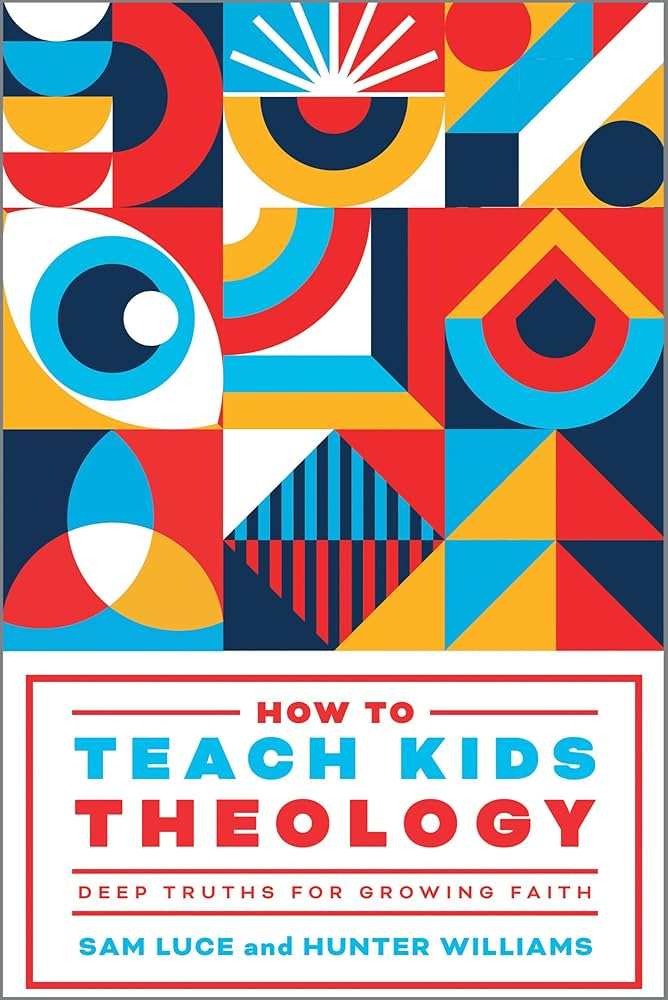
Title: How To Teach Kids Theology: Deep Truths For Growing Faith
Author: Sam Luce & Hunter Williams
Published: New Growth Press, 2025
Disclaimer: Both Sam and Hunter are friends in ministry, and you will recognise Hunter as one of my co-hosts on the Cross Formed KidMin Podcast. Regardless, I’ve done my best to offer an honest and useful review for children’s ministry leaders.
Last instalment, I reviewed Sustainable Children’s Ministry and the “simple machines” that can make the role of the Children’s Minister more effective and … well, the hint’s in the title … sustainable.
Today, I’m swinging from practical systems across to the importance of theological knowledge in the children that we lead. However, let’s not be fooled into assuming a false dichotomy between theology and practice. One of the greatest aspects of Luce and Williams’ How To Teach Kids Theology is the movement in each chapter from rich theological description through to embedded practice in the children’s ministry space.
The authors bookend the text with a concern for the lack of theological depth they discern in many children’s ministry contexts and a call for taking both kids’ spiritual development and theological engagement seriously. “The need for depth and richness of theological truths in our children’s ministries and churches has never been more necessary” (p.173).
Both Luce and Williams have worked extensively in local evangelical churches’ children’s ministry as well as parachurch organisations such as Awana. Their theological context is therefore conservative, Protestant, and evangelical. However, there is a generosity, particularly in the chapter on ‘Orthodoxy and Theological Charity’, when outlining “disputable matters” such as the mode of baptism or Calvinism vs. Arminianism. Even those from other theological traditions outside evangelicalism, who may weigh some matters differently, or nuance language to fit their context, will find that How To Teach Kids Theology encourages and equips them for the important task of … well, again, the hints in the title … teaching kids theology.
The Big Idea
Here’s one key quote that summarises the heart of the book:
“Our desire is that this book becomes a tool that instructs you and empowers you to take God’s Word seriously. Your kids will never see the beauty of Christ or the loveliness of Christian doctrine if you don’t find Christ and his teachings beautiful” (p.173).
Key Chapters
As I mentioned above, this book is not a work of theoretical theology divorced from the messy work of ministry with children. Each chapter outlines the problem, the principle and the practice of teaching theology to kids.
Here are a couple of chapters and key quotes that I’ve found most helpful in my ministry:
Chapter 1 - Seeing The Great Lion
With the first of several references to Narnia, this chapter sets the scene by critiquing children’s ministry experiences that give a simple caricature of God, rather than seeking to expand the horizons of kids’ imagination of how great and awesome God is.
“If we want our kids to stand firm in a culture that suppresses the truth of Christianity, we need to give them a grand view of God that overwhelms their hearts and fills them with wonder. Our children’s resolve is only as strong as the God they believe in, and if the God they believe in is presented to them as nothing more than a small deity, their loyalty will follow suit.” (p.10)
Notice a theme that carries throughout the book: a child’s conceptual theology is necessarily and immediately relevant to their ongoing love for and obedience to God. More concisely, orthodoxy leads to orthopraxy.
Chapter 5 - Simplifying vs. Distilling Theology
We want to teach children the truth in ways appropriate to their age and developmental stage. Luce and Williams’ distinction between simplifying and distilling theology is one of the most helpful and lasting principles in the book. To simplify is to “remove as much complexity as possible to get down to the fewest possible parts or requirements.” To distil, on the other hand, is to “keep the essentials and remove the unnecessary things.” This may sound like a distinction without a difference. However, when it comes to teaching theology to children, it is profound.
With reference to simplifying faith, the authors write,
“We try to make it so accessible and safe that we inadvertently inoculate our kids from faith. They get just enough of God that when life hurts, our kids apply what they learned about God [but]… the simple faith they grew up in isn’t powerful enough for the deep sorrows and dark nights. They tried faith, and it didn’t work.” (p.87)
However,
“Distillation is so powerful because you are not giving your kids a faith that they will grow out of … you are giving your kids a faith to grow into. When you distill truth, you refuse to compromise the truth… When you distil truth, you create categories in the mind of your kids that they need when they get older.” (p.88)
Distilling, rather than simplifying, takes much more work, but it is worth the effort. For more on this topic, see my article below on why analogies of the trinity fail.
Why Analogies of the Trinity Fail

It is a great joy to teach children the deep truths of the Christian faith. I can still recall moments when eyes have lit up with understanding or when brows, furrowed with concentration, have released as God’s truth has sunk deep into the minds and hearts of the children in the room.
Chapter 6 - Orthodoxy and Theological Clarity
To our shame, evangelicals are not known in this cultural moment as being marked by charity. So it is refreshing to see Luce and Williams bring both theological clarity and theological charity together in this chapter. Christians are to be known by their love for one another (Jn. 13:35), and once again, the book helps the reader move from concept to children’s ministry practice.
“If external, historical, and biblical truth is our standard, if charity is our mode, and if love is our goal, we will be able to teach our kids not only what is true but also how to live that truth in a life marked by love for God—love which is seen by others in our love for people.” (p.115)
Nit-Picky
No book is perfect. Here are a few pernickety comments to keep in mind.
Definition of Theology
The authors borrow John Frame’s definition of theology as “the application of God’s revelation to all of life” (p.18). This is vastly different to a dictionary definition like Merriam-Webster’s “the study of religious faith, practice, and experience, especially: the study of God and of God’s relation to the world”.
What I’ve since discovered is that it has become a right of passage for systematic theologians to come up with their own bespoke definition of ‘theology’ that suits the particular spin that they want to give to their academic task. While I don’t have a problem with Frame’s definition per se (and have generally quite appreciated Frame’s theological perspective on a number of topics), it does frustrate me that there is not generally agreed upon term within the literature.
The danger of nuancing your own definition of ‘theology’ is that you can pack an awful lot of presumptions into your definition. Writing from within a Reformed perspective, it makes sense that Frame highlights “God’s revelation”. However, he prioritises “application”, as opposed to “study of” or “knowledge of”.
Like Luce and Williams, I appreciate both the democratisation, and practical nature, of this approach. It “doesn’t give the impression that a person has to be an expert or elite Christian to be a theologian” (p.18). However, I’m still left feeling like Frame has somehow cheated by included the application of Christian doctrine as a necessary part of his definition of that doctrine. If ‘theology’ is “the application of God’s revelation”, then what do we call the understanding of that revelation, or in fact, the revelation itself?
Conclusion
Pedantic comments aside, I highly recommend How To Teach Kids Theology to children’s ministers, ministry leaders and college students alike. It provides a clear outline of theological concerns and grounds them in the practice of our weekly ministry to children and families.
Thanks for reading this instalment of Growing Disciples: Book by Book. If you have suggestions for future books worth reviewing, please leave a comment below.