

On Sunday 14th December, two men opened fire on a Jewish Hanukkah celebration at Bondi Beach in Sydney, killing 15 and injuring a further 40. It was Australia’s worst mass shooting in nearly 30 years. That same day, Soul Revival Church was preaching on the question ‘God, why can’t I find peace in my life?’, a sermon now read through a very different lens. Below is the text of the sermon I preached, without revision due to current events. By God’s sovereign design and grace, I pray that it may offer some comfort in this particular week, but also for all those asking God this question at any time and in any situation.
SCRIPTURE READING: JOHN 14:15-27
This week, we are continuing with our series, “God, why…?”
The question that we are asking this morning is “God, why can’t I find peace in my life?” Like our previous questions, this one has been generalised from a number of similar questions that our church submitted earlier this month. Here are two of the specific questions that you asked:
How do I find peace and protection for myself and my family?
Life & work feels like an endless cycle; we might grow in experience and skill over time, but it feels like it never goes anywhere. How can I ever find time to develop matters of the soul/spirit when life is always so busy?
Do these questions sound familiar? Do they resonate with how you’ve felt at any time in the past, in the past year, in the past week?
Like the other questions that we’ve had in this series, these questions are eternally true. They have gripped the heart and mind of people across the globe, across cultures, throughout all of human history.
Questions of both inner and external peace and protection. Peace can mean both the absence of war, poverty and strife, but we also, rightly, use the word to describe our inner thoughts and emotions. We know when our thoughts, our inner life, is peaceful, or whether it’s anxious, or distressed, or depressed.
So in this first question, we’re asking how I find this peace and protection for me and my family or my loved ones; both outer and inner peace, where does this come from? How do I find it? How can I secure it?
And this second, longer question, connects two of the specific areas in which we can feel either peaceful or anxious, stable or unstable, settled or unsettled: (1) our life/work balance, and (2) our spiritual life. How do I get a break from the monotony of everyday life, and in the midst of the business and weariness of life, how do I make time for my devotional life?
Now of course, we are going to turn to the Bible and get some answers to these questions. But before we do, I want to pause and recognise the reality of these questions. As I’ve already said, these are universal questions, we are not the first generation, nor the last, that will strive after peace, wondering if we will ever get there. It is important to recognise this. Firstly, because there is a strange comfort in solidarity. Ironically, there is a peace that comes from knowing that we are not the only ones searching for peace.
But more importantly, stopping to recognise the scope of this problem helps adjust our expectations for this morning. I am not going to comprehensively answer a cross-global, cross-cultural, cross-historical, cross-generational, eternal longing of the human heart in the next 20 minutes. What I am going to do is point towards the path of peace, and then, as always, invite you into the life-long journey of faithful discipleship to King Jesus that is the life of the Christian.
If you were here three weeks ago when I launched this series, I set these three ground rules for when it comes to asking God questions and searching for answers in the Scriptures:
God is a person, not a concept (which means that when we answer these questions, we are ultimately chasing relationship, not knowledge)
Discipleship is about faith, not trivia (which means that being a Christian has nothing to do with how smart you are, or your ability to remember stuff, or your ability to understand or keep up with everything I say this morning; though I do pray that God will make some of what I say particularly applicable for you)
Faith formation (growing as a Christian) is inefficient (it takes time, it is slow, it is—as Eugene Peterson would say—a long obedience in the same direction; which means you may not walk out of today’s sermon more at peace, but if you keep walking with Jesus by his Spirit, you can experience his peace)
So here’s where we’re headed over the next 20 minutes or so:
Peacelessness in 21st Century
Peace that Christ gives
Walking in that peace
Peacelessness in the 21st Century
Here’s some US data that shows the increase in anxiety over the last 10 years.
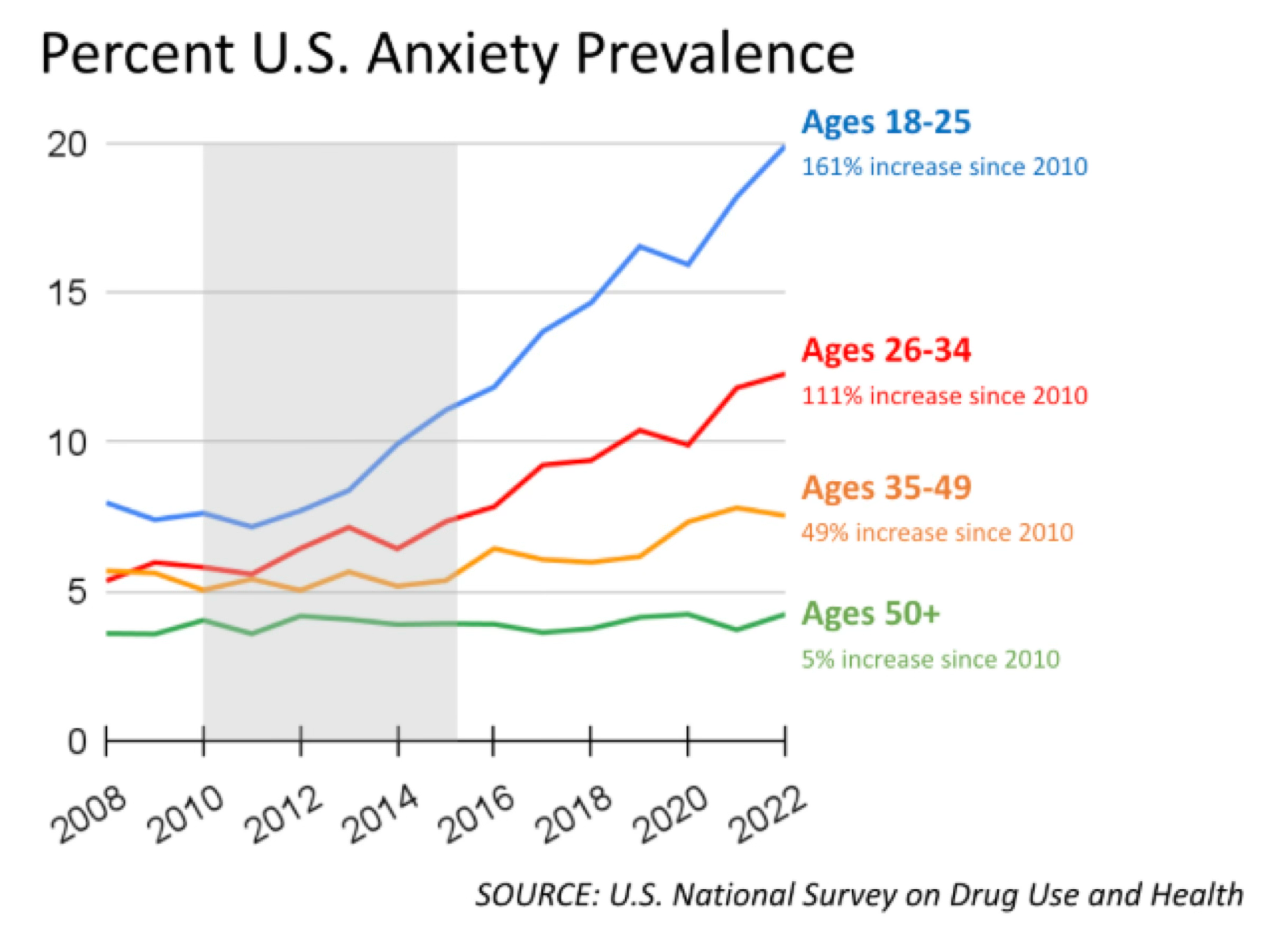
If you feel like your peacelessness has increased over the last decade, you’re not imagining it; in fact, you’re exactly on trend! Only the over-50s have had no discernible increase in their anxiety. Now, that’s statistically speaking. It may or may not be true of you personally.
And teens, do you notice that there is a lot of depression going around?

Maybe you feel depressed or anxious, maybe it’s friends at school or others you see on the playground? Again, you’re not imagining it. There is a huge increase in the number of high schoolers who are majorly depressed.
Now these are US data. But we can see the same thing happening in Australia.
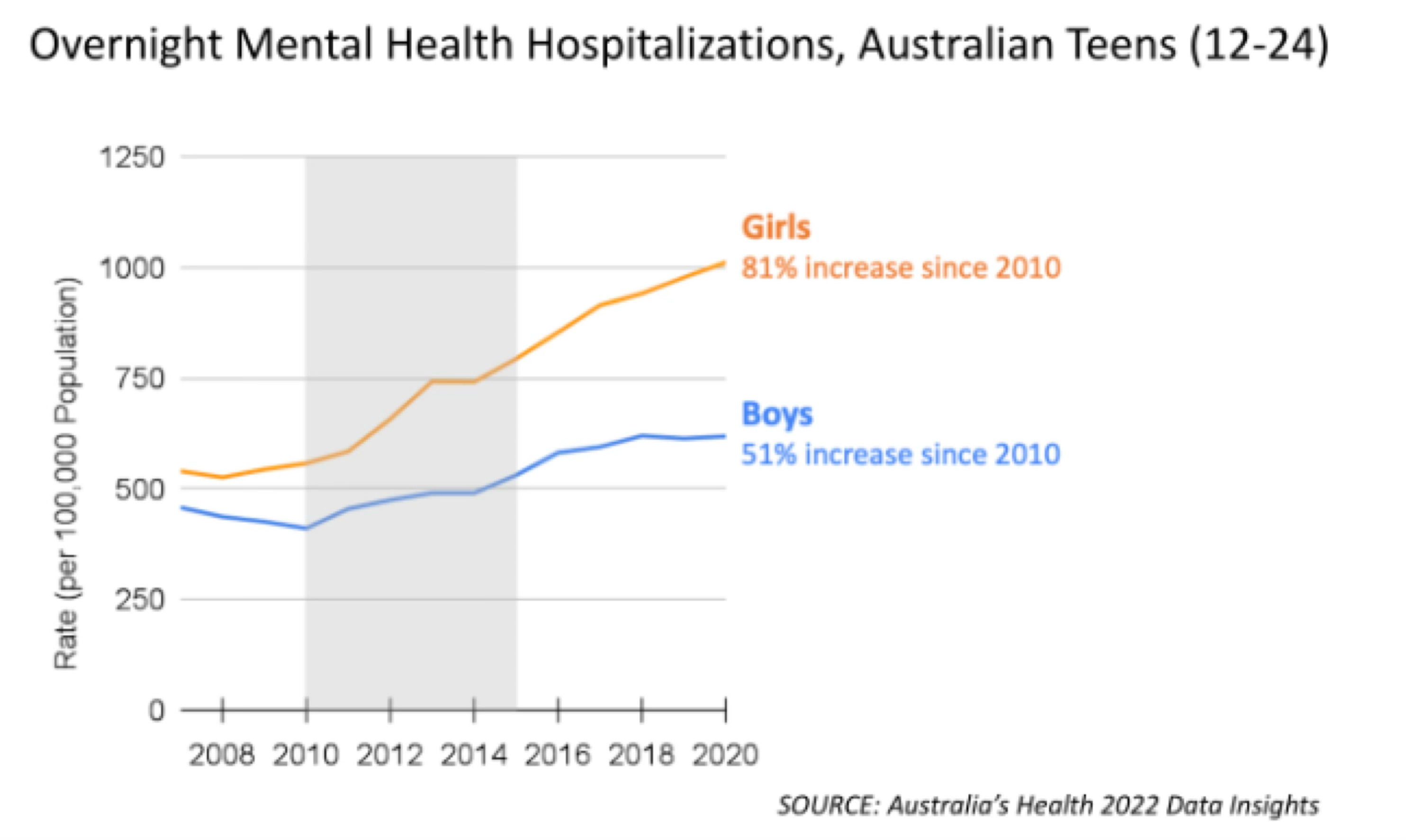
This shows the increase in overnight mental health hospitalisations for Australian teens and young adults.
81% increase for girls in the last decade
51% increase for boys in those who have had to have overnight hospitalisation because of mental health concerns
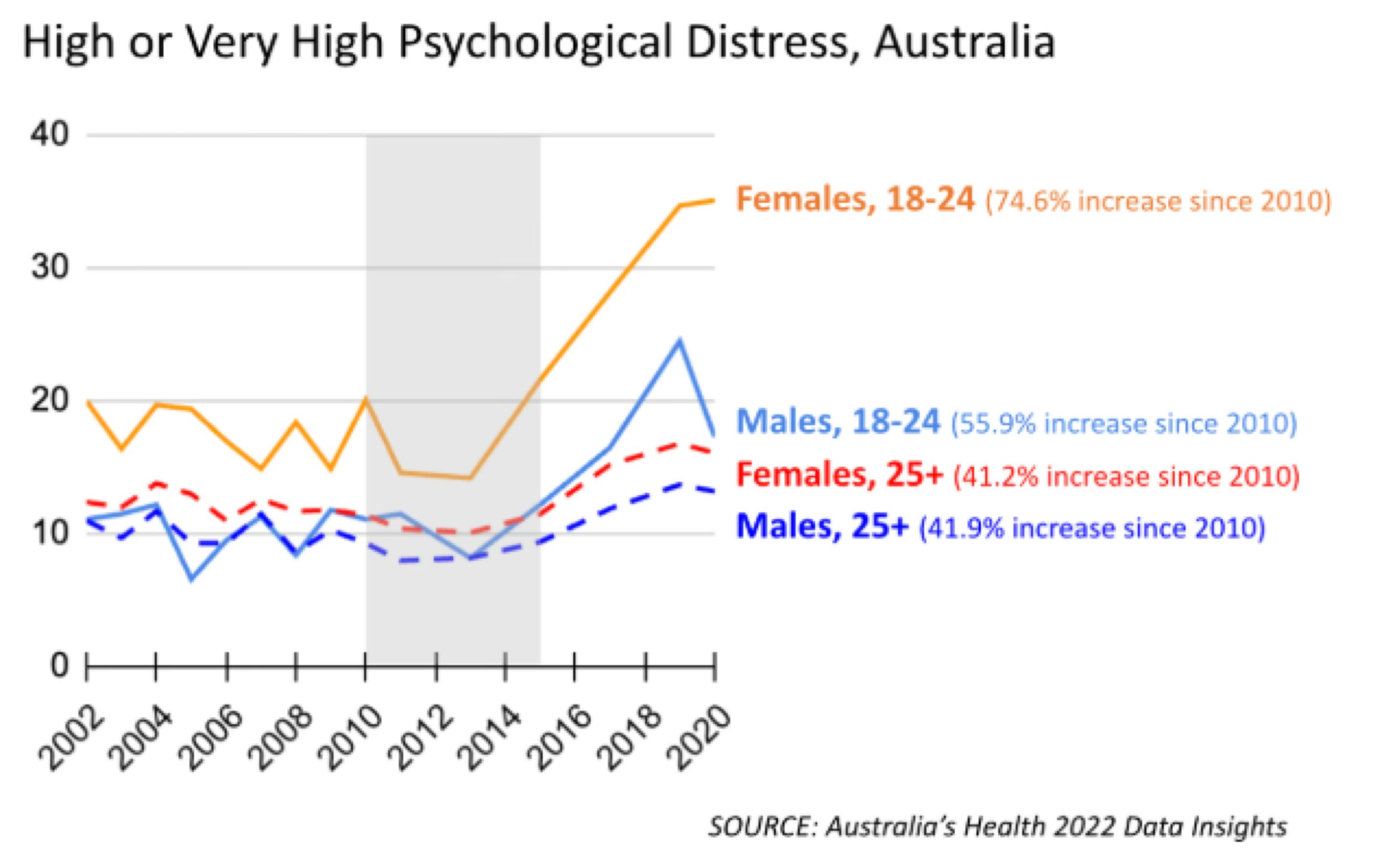
Also in Australia, the number of young adults who self-report that they have high or very high psychological distress have all increased, and the most significant demographic are girls aged 18-24.
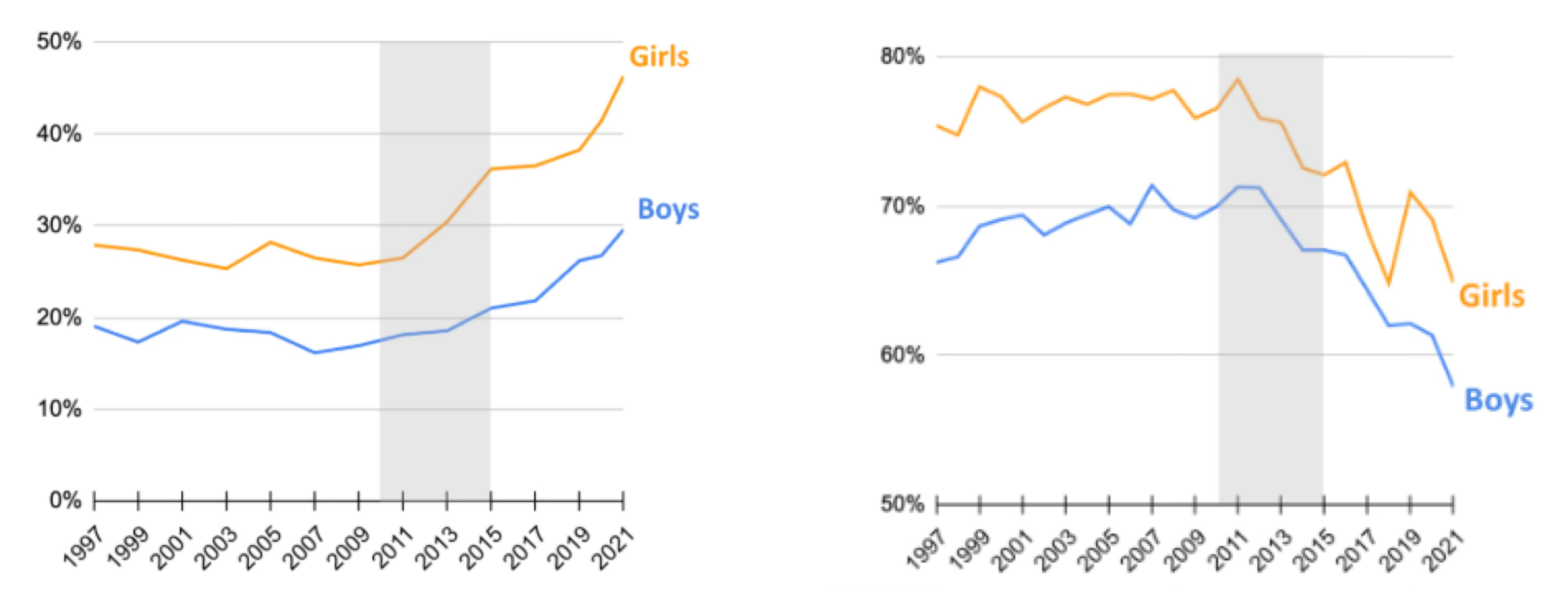
More data: on the left, the percentage of US high schoolers who agreed or somewhat agreed with the statement “A lot of times I feel lonely.” Steep rise in loneliness.
On the right, the percentage of US high schoolers who reported having a few friends to hang out with is decreasing. Steep decline in friendship.
And last one…
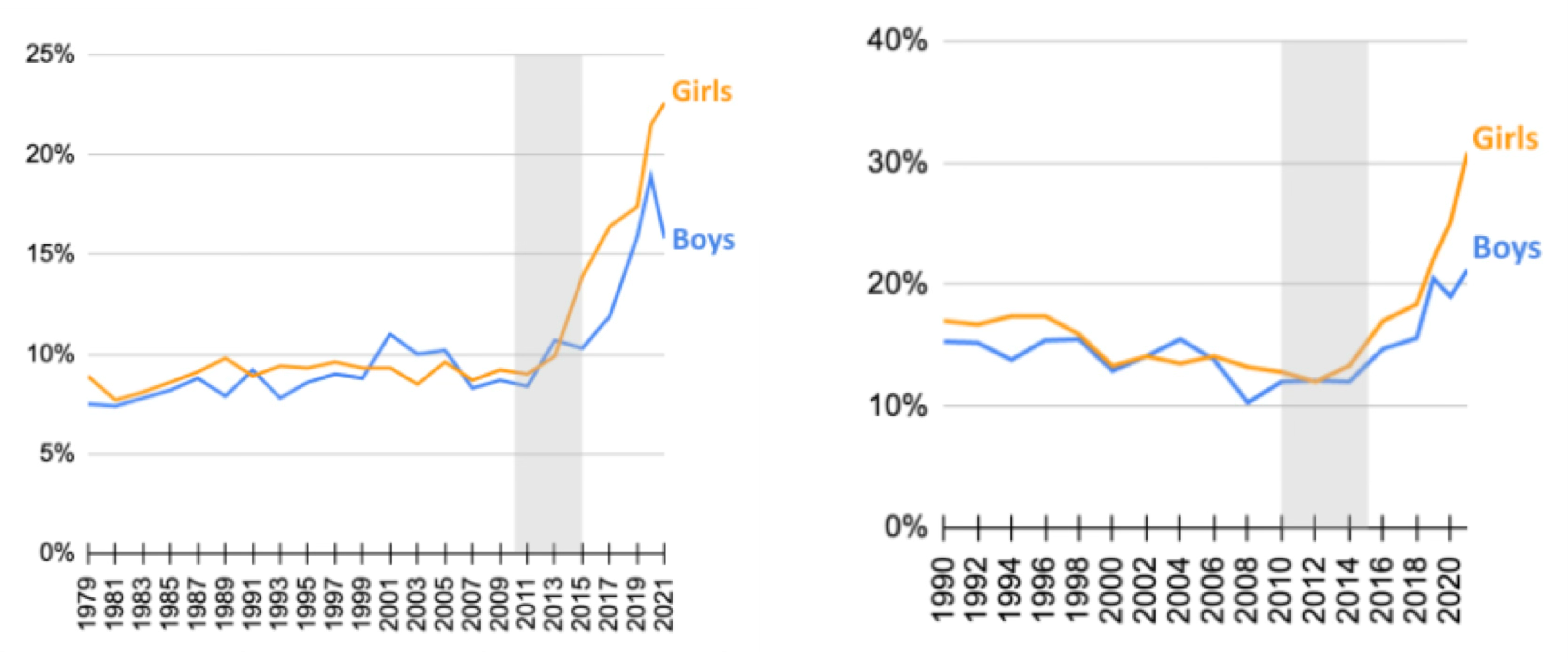
On the left, the percentage of US year 12 students who agreed or somewhat agreed with the statement “I feel that my life is not very useful.” Steep rise in existential despair. And the same again on the right, a steep increase in the percentage of USA year 12 students who agree with the statement “Life often feels meaningless”.
Anxiety, depression, mental health hospitalisations, psychological distress, loneliness, friendlessness, lack of meaning, lack of value and purpose.
The questions are very real and speak to a deep part of who we are. This may not be your question. Even with all these increases in anxiety, and decreases in sense of meaning, the majority of people in these surveys didn’t suffer from high levels of psychological distress, and most people would say that their life had meaning. But even if it is not your question and not your story, then it is likely someone that you know, it is likely someone in your family, and it is certainly someones in your church family. And I know that, because someone at Soul Revival Church asked these questions on our survey.
So there is a peacelessness that we are facing, maybe as individuals, but certainly collectively as a culture. And we’re going to come back to some of the possible causes of this rise in anxiety and peacelessness in a moment.
But before we do that, I want to come back to the Scriptures to see what God has to say about peace and how we can find peace.
Peace That Christ Brings
So let’s go back to the passage that Ian read for us from John 14. In this section, Jesus weaves together several threads. One is that being a disciple of Jesus means loving him and obeying his commands; the second thread through this section of John is Jesus’ promise that he will send his disciples “another advocate”, the Holy Spirit, who will be Christ’s presence with them while he is away from them.
“If you love me, keep my commands. And I will ask the Father, and he will give you another advocate to help you and be with you for ever – the Spirit of truth.”
John 14:15-17
And then as Jesus builds towards the end of this section he says,
“Anyone who does not love me will not obey my teaching… But the Advocate, the Holy Spirit, whom the Father will send in my name, will teach you all things and will remind you of everything I have said to you.”
John 14:24-26
Then (and here’s the link with today’s question) Jesus finishes with…
Peace I leave with you; my peace I give you. I do not give to you as the world gives. Do not let your hearts be troubled and do not be afraid.
John 14:27
Where does peace come from? Jesus! Peace is a gift from Jesus. But what were the threads that Jesus ties together to get to this endpoint? Love of and obedience to King Jesus on the one hand, and the presence of the Holy Spirit on the other hand.
Here’s what I want you to understand. The peace that Christ gives, the peace that calms troubled minds and keeps us from being afraid, is both a gift given by the Spirit and an act of obedience empowered by the Spirit. Christ gifts us peace, and he calls us to enact peace, chase after, pursue peace, wherever we go.
When we see this, it helps make sense of several other passages in the Bible that talk about peace. I’m going to throw a whole lot of passages at you. My intention is to overwhelm you. Don’t try and keep up. Just sit back and notice the gift and obedience dynamic that is happening in these verses. You ready?
Turn from evil and do good; seek peace and pursue it.
Psalm 34:14This is what the Lord Almighty says… Love truth and peace.
Zechariah 8:19You must have the qualities of salt among yourselves and live in peace with each other.
Mark 9:50Strive for full restoration, encourage one another, be of one mind, live in peace. And the God of love and peace will be with you.
2 Corinthians 13:11Let us therefore make every effort to do what leads to peace and to mutual edification.
Romans 14:19Let the peace of Christ rule in your hearts, since as members of one body you were called to peace.
Colossians 3:15The mind governed by the flesh is death, but the mind governed by the Spirit is life and peace.
Romans 8:6But the fruit of the Spirit is love, joy, peace, patience, kindness, goodness, faithfulness, gentleness and self-control.
Galatians 5:22-23I have told you these things, so that in me you may have peace.
John 16:33
So the peace that Christ gives is both a Spirit given gift and a Spirit enabled act of obedience.
So… we’ve got a good idea of what the peace the Christ gives is, but how does that help answer our questions?
Walking In Peace
Let’s take each of our questions one at a time, and as we do, we’ll start exploring the third and last section of the sermon this morning. How do we walk in step with the peace that Christ gives?
So let’s start with this first question, “How do I find peace and protection for myself and my family?”
It’s a great question, but I just want to make one small but significant change. Perhaps the question isn’t so much “How do I find peace…” but … knowing that peace is a gift, and an act of obedience, we might ask, “How do I RECEIVE the peace that Christ has already offered and given for myself and my family?”
And if this is the question that we ought to be asking, then Paul has a great answer for us in Philippians.
How do we receive the peace that Christ has already and will continue to gift to us by his Holy Spirit?
Do not be anxious about anything, but in every situation, by prayer and petition, with thanksgiving, present your requests to God. And the peace of God, which transcends all understanding, will guard your hearts and your minds in Christ Jesus.
Philippians 4:6-7
Through prayer. All of those anxieties we carry with us for ourselves and our families—all of the financial stresses, all of the relational burdens and heartaches, all of the medical emergencies, all of the friendship concerns, the depressive thoughts, our studies, our employment, the lack of meaning and purpose that we feel, the barrage of news and current affairs—every situation, by prayer and petition, with thanksgiving, present your requests to God. And, as we do this, in the midst of our prayers and petitions, “the peace of God, which transcends all understanding, will guard your hearts and minds in Christ Jesus.”
As I read this this week I wondered … How? How can prayer bring about peace? And how can peace “guard” our hearts and minds?
And then I realised, that the answer was already in my sermon from last time.
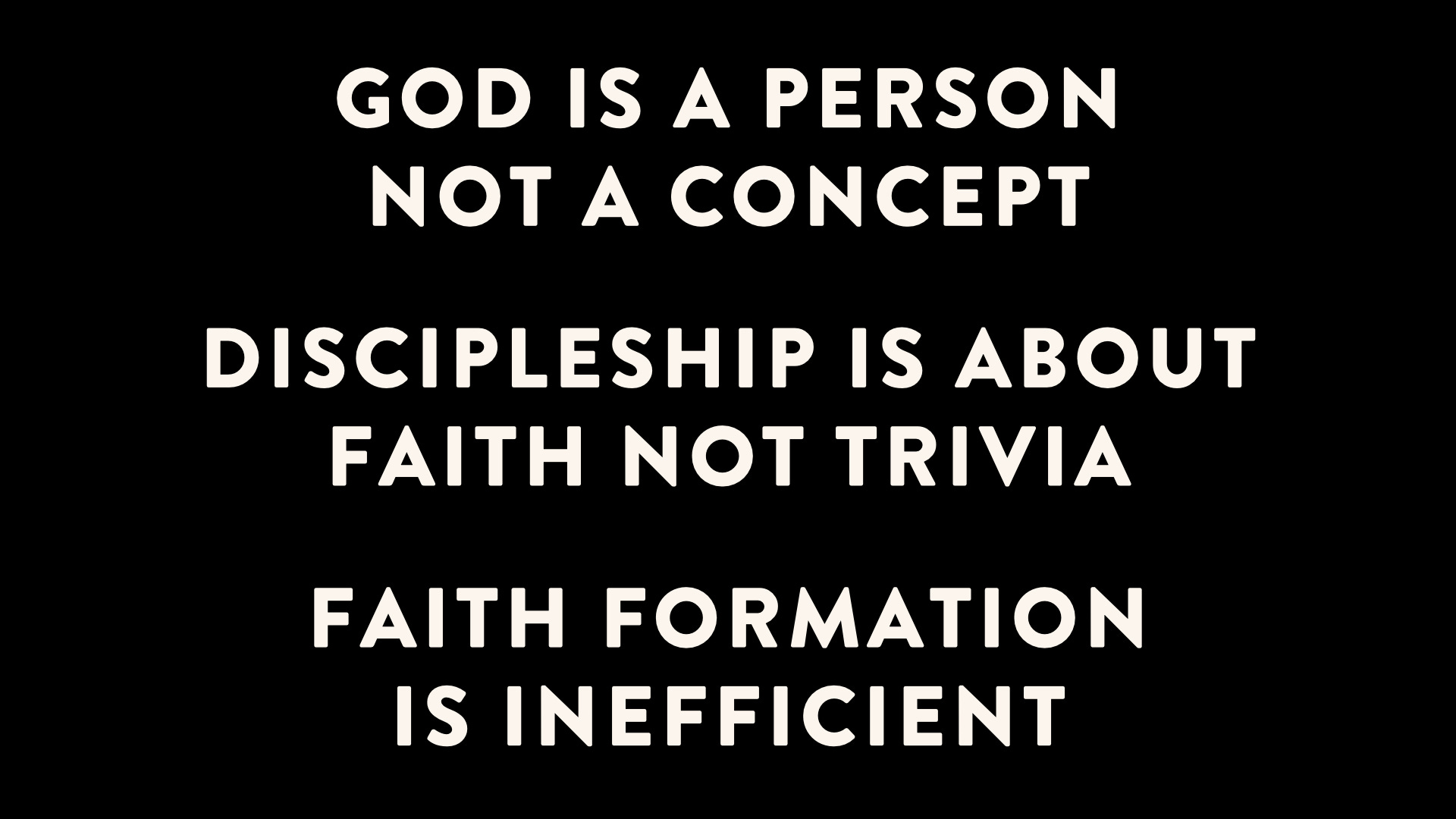
It is because prayer is an expression of these foundational truths: prayer is an expression that God is a person and that I am in relationship with him, prayer expresses discipleship by expressing faith, and prayer, ongoing in every situation, is an expression of the slow walk of obedience that is my growing discipleship to King Jesus.
And then I read Gordon Fee’s commentary on Philippians, who of course said it much better than I could.
“Peace comes because prayer is an expression of trust, and God’s people do not need to have it all figured out in order to trust him.”
Gordon Fee
It comes back again to the foundational idea that God is a person, not a concept. When I pray, I entrust myself to him. And, notice, whether he answers my prayer or not! The peace that comes, the peace that guards our hearts and minds, does not come from answered prayer. It comes from the act of praying. Peace is received through the process of expressing my trust in a good, good Father and presenting my requests to him.
How do I find [RECEIVE] peace and protection for myself and my family? Through the gift of peace received through prayer and petition; bringing everything to God who cares for you.
That’s not a full answer, we have to keep living it out together, but it points us in the right direction.
Finally, our second question: “How can I ever find time to develop matters of the soul/spirit when life is always so busy?”
There are many reasons that our lives are busy, and there is no cookie-cutter answer that will work for any of us (another reason why we need to keep working out these answers in community, over the long term). But there is one reason that is common for many of us.
Let’s go back to our graphs from the start of the sermon. They all have one thing in common. All these spikes up or spikes down occur during the window of 2010-2015; notice the grey bar. Why? What happened then?
Three things were born or became mainstream during those years:
Front-facing cameras on our phones
Image-centred social media apps such as Instagram and Snapchat (+ increase of images on older social media like Facebook and Twitter)
Mass-adoption of smartphones, especially amongst teens
Here’s the graph that ties some of our threads together this morning: the rise in depression, the more hours you spend on social media.
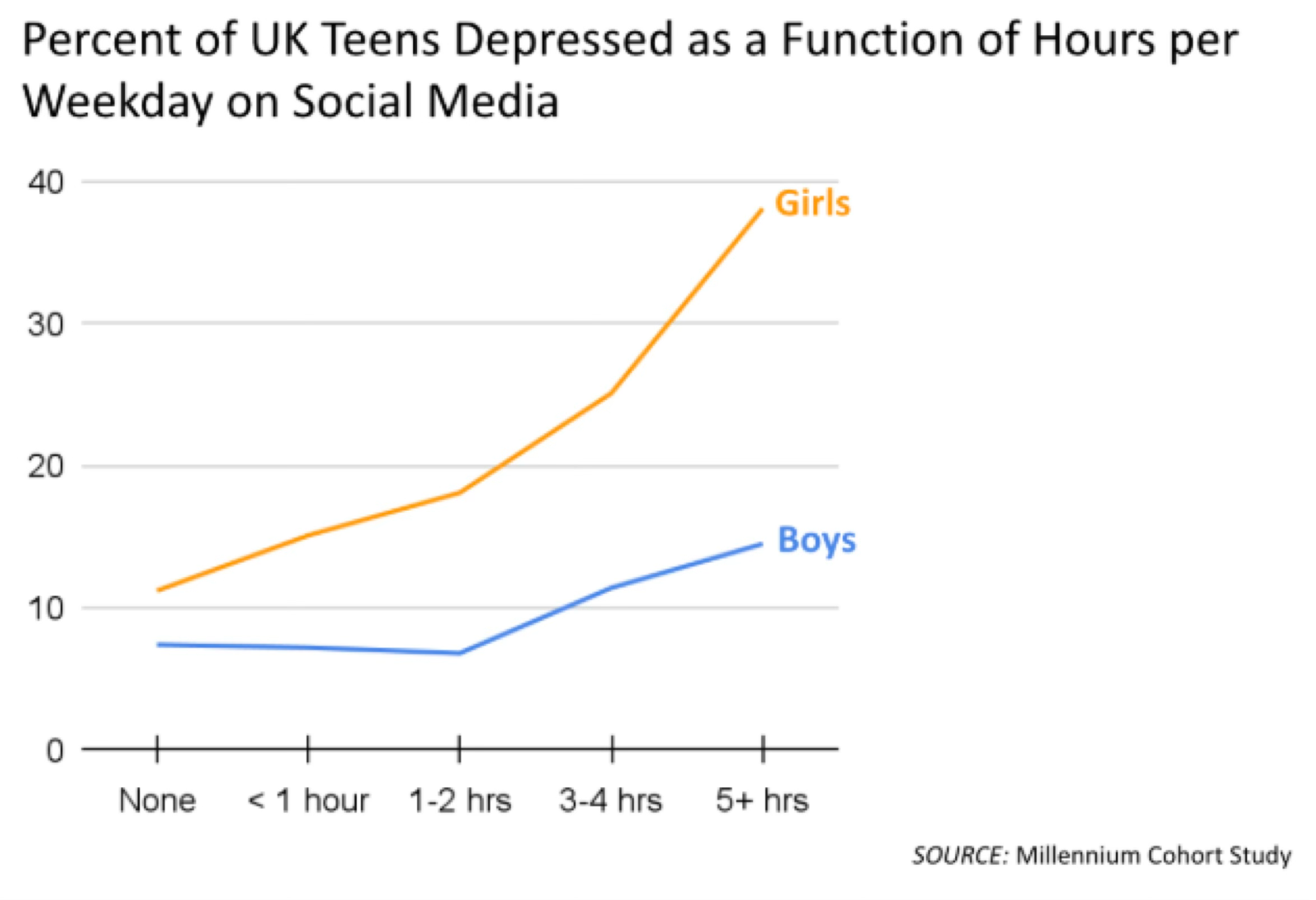
Screen time and social media are not the only culprits. Many other things cause us anxiety, depression and peacelessness than just these things. Notice that there is a baseline depression in teens who spend no time on social media.
However, there is a strong correlation between social media use and peacelessness.
And it’s not only amongst teens. Here’s one political cartoon that I saw on Facebook this week.
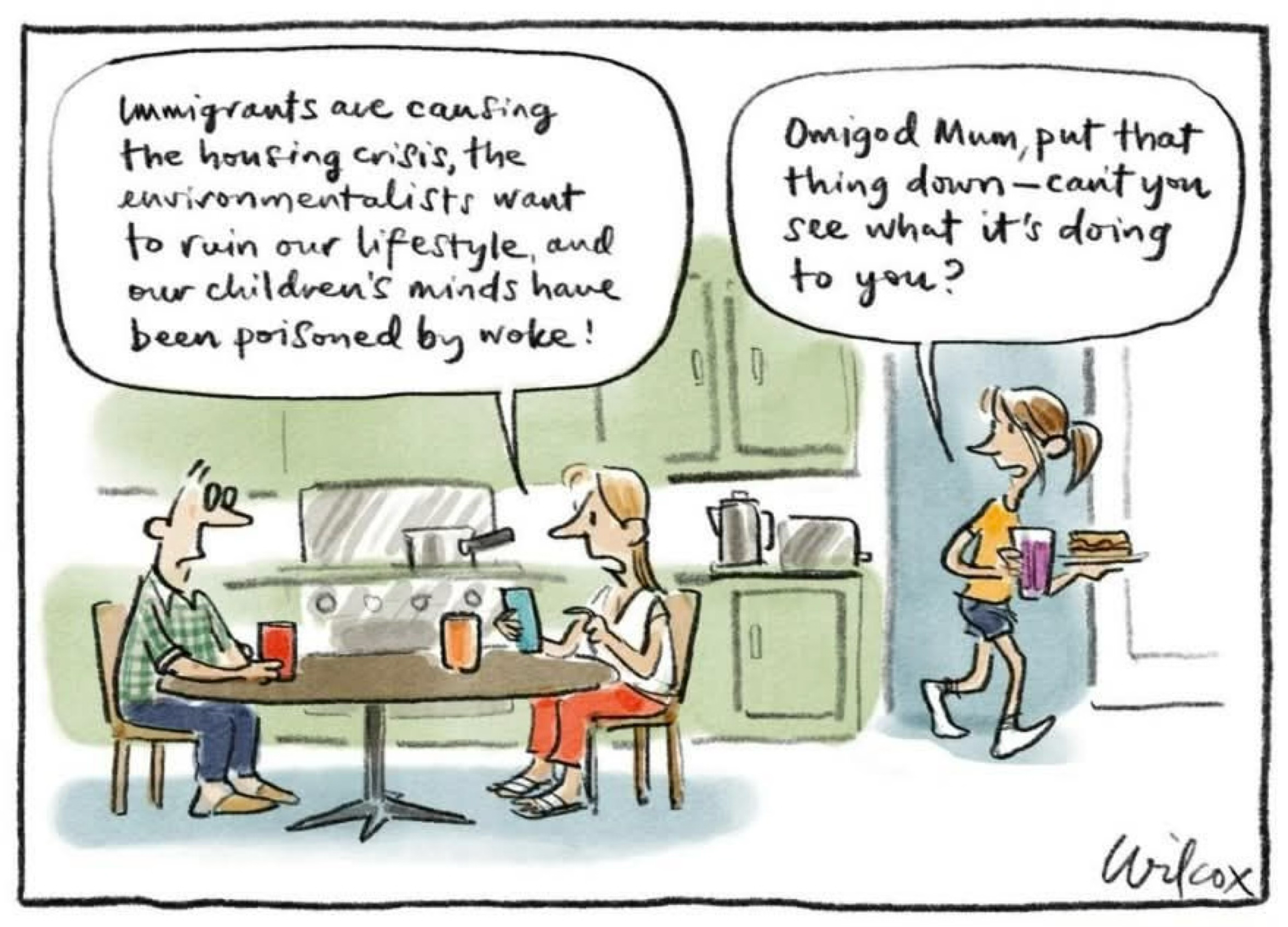
Yes, I know, I see the irony too. But it’s a good reminder for many of us, no matter what age we are, that we are all being shaped by the media we consume. And that media is largely on the internet, largely through algorithmically curated social media, largely through our smartphones, and typically not shaping us in a Christ-ward direction.
Another great book I’ve enjoyed reading the last two weeks has been this one, Digital Liturgies by Samuel D. James.
There’s so much in here we could comment on, but here’s just one quote from towards the end of the book.
“The web is a habitat of discontentment… The more we’re deeply plugged into the web, the more scrambled and exhausted we will be.”
Samuel D. James
God, why can’t I find peace in my life? How can I ever find time to develop matters of the soul/spirit when life is always so busy?
By no means the only reason, but perhaps part of the reason for why you and I are not developing better spiritual habits and practices that not only draw us closer to God, but also reduce our levels of peacelessness, is because our time and attention and business is actually being consumed by habits that distract and disconnect us from the life that God wants us to live.
Conclusion
If you would like to dig further into this topic, here are three books I have found particularly helpful. All the graphs come from Jonathan Haidt’s book The Anxious Generation. The Extinction of Experience by Christen Rosen has also been excellent review of the digital world from a secular journalist. And for an explicitly Christian perspective, check out Samuel James’ Digital Liturgies.
But here we go, in a nut shell.
How do I find peace and protection for myself and my family?
In every situation, by prayer and petition, with thanksgiving, present your requests to God.Life & work feels like an endless cycle; we might grow in experience and skill over time, but it feels like it never goes anywhere. How can I ever find time to develop matters of the soul/spirit when life is always so busy?
Form habits and practices that draw us into life with God, not distract us with digital frivolities.
Remember, these are only partial answers. This is not everything that can be said or even should be said about these topics.
As we go into morning tea, perhaps keep these conversations going. And of course, Community Groups and conversations during the week are the best way to keep these ideas percolating in your mind and soul.
While my sermon was not recorded, you can hear Jai McMordie preaching on this same question at our Miranda MCC congregation via the MCC YouTube page.