

The ‘Colours of Life’ are a series of five colours that Soul Revival Church has used extensively over the years to summarise the story of Scripture. This January, we are using these colours to preach through an overview of the biblical narrative. Like I say regularly to the children of Soul Revival, the Bible is a big book, but if you can remember five colours and what they stand for, you can know the key moments in the story and how you fit into the story of Scripture. Find out more here.
Below is the text of my first sermon in this series on Creation.

Sermon Passage: Genesis 1:1-2:3
The Colours of Life
This morning we are starting our new series on The Colours of Life. This is a series of five colours that we have used extensively throughout the life of Soul Revival to summarise the story of Scripture. As I have said countless times to the kids and youth here, and in Scripture classes at school, if you can remember five colours and what they mean, you can know the whole story of Scripture. It’s a big book, but with five colours, you can know the key movements in the story and how YOU fit into the story of Scripture.
Here they are:
GREEN stands for CREATION; in the beginning, God made everything
WHITE stands for LIGHT; the light that comes from a perfect, unadulterated friendship with God
BLACK stands for DARKNESS; the darkness that comes from our sin and how that sin breaks our relationships with God and puts us under judgement and death.
RED stands for JESUS; both his love and his blood, which through the cross cleanses us from the stain of sin and redeems us from the judgment that our sin puts us under.
GREEN, WHITE, BLACK, RED, YELLOW: if you can remember these five colours, you know the whole Bible story.
In The Beginning
This morning, we are starting with GREEN, which stands for CREATION. Before we dig into Genesis 1:1-2:3, our text for this morning, let’s play a little game of spot the difference.
Can you spot the difference between these two drainpipes? What do you notice?

What about these balcony windows?

Or these public bubblers?

Did you catch it? The first picture in each set are functional. They do the job they were designed to do. They are perfectly adequate, thank you very much. The second picture in each pair, however, are functional… but also… curious, fun, interesting, beautiful. They don’t just do the job they were designed to do; effort has gone into what they “look” like.
Keep that in mind, because it is an important point that we are going to come back to in just a moment.
But first, as we get into this GREEN colour, the colour of CREATION, and we start to explore Genesis 1, there is an important caveat that need to address. An elephant in the room that needs naming. And that’s what Genesis 1 is NOT about, and therefore what this sermon is NOT about.
Genesis 1, and certainly where we are going this morning, is NOT about the Bible versus science. It is certainly NOT about the debate between young earth creationism versus old earth and evolutionism. These are not the questions that the Ancient Near Eastern Hebrew world was asking, and therefore, they are not the questions that the author of Genesis is seeking to answer.
I don’t mind having that conversation, I’m happy to have that conversation. But when it comes to understanding Genesis 1, there is a great warning from Old Testament scholar John H. Walton and his wife Kim E. Walton in their book The Bible Story Handbook.
“Do not try to turn this into a science lesson, for such an emphasis misses the point entirely… Speak of the Bible’s message in the Bible’s terms.”
And so that is what we are going to do. To let the Bible speak in it’s own terms, so we can see as clearly as possible what the Bible’s original authors want us to understand about Genesis 1 and this story of Creation. And that is this (also from Walton & Walton):
“The message of Genesis 1 is that God is the one who made our world work.”
Creation has a purposeful order, infused necessarily with a gratuitous beauty, and all of this ordered beauty is pointed towards climactic rest.
Understanding this, will start us out on the right path as we seek to understand the story of Scripture through the colours of life.
Purposeful Order
In the beginning God created the heavens and the earth. Now the earth was formless and empty, darkness was over the surface of the deep, and the Spirit of God was hovering over the waters.
Genesis 1:1
The first thing that the Bible tells us is that God created everything. Which of course leads to the question… “Who made God?”
To which the answer is, “no one made God, God always existed”. That is really hard for our brains to wrap our heads around. Everything we know has a beginning. But that’s what makes God, God. He had no beginning. But from him, everything else has a beginning.
Two words ought to jump out at us from this section: FORMLESS and EMPTY.
God creates the heavens and the earth, he’s built his canvas, made the frame, stretched the fabric, but it’s formless, empty and dark. He still needs to give it shape and form and colour. But, we have hope and anticipation, because over the dark nothingness, the Spirit of God is hovering. *GASP* What’s he going to do next…?
If the problem is that the earth is formless and empty. The answer of course is going to be to form it and fill it. So that’s exactly what God does.
Day 1, he forms light and separates is from darkness, so now, we have day and night.
Day 2, he gives form to the waters by separating the waters above from the waters below, therefore making the sky (where the rain waters come from) and the sea.
And then Day 3, God forms the earth itself, separating the waters away from the dry ground, thereby making land that is distinct from the sea. He also forms on the land vegetation, a habitat, a home. What for? Oh… not yet, you’re getting ahead of yourself!
By the end of three days we have gone from “formless” dark, watery, nothingness, to “formed”. We now have form and structure to where light and dark should be, where sky and sea should be, and where land and oceans should be.
God has solved half of the problem. The other problem being that the creation is … EMPTY.
And so God fills it. And notice how he fills each of the forms that he has made.
On Day 4, the form of day and night, he now fills with sun, moon and stars.
God has formed the waters above in the sky and the waters below in the sea, and so on Day 5 then he fills both sets of waters, creating birds and sea creatures.
And finally, he has formed the land by separating it from the sea, and so on Day 6 he then fills the land with land animals, including humans. We’re going to spend a lot more time on the creation of humans next week when we get to the White colour of life.
For now, the focus is on the purposeful order of God’s creation.
From formless and empty, to formed and filled. In a clear pattern, the kind of order that any engineering or mathematically inclined mind would be proud of.
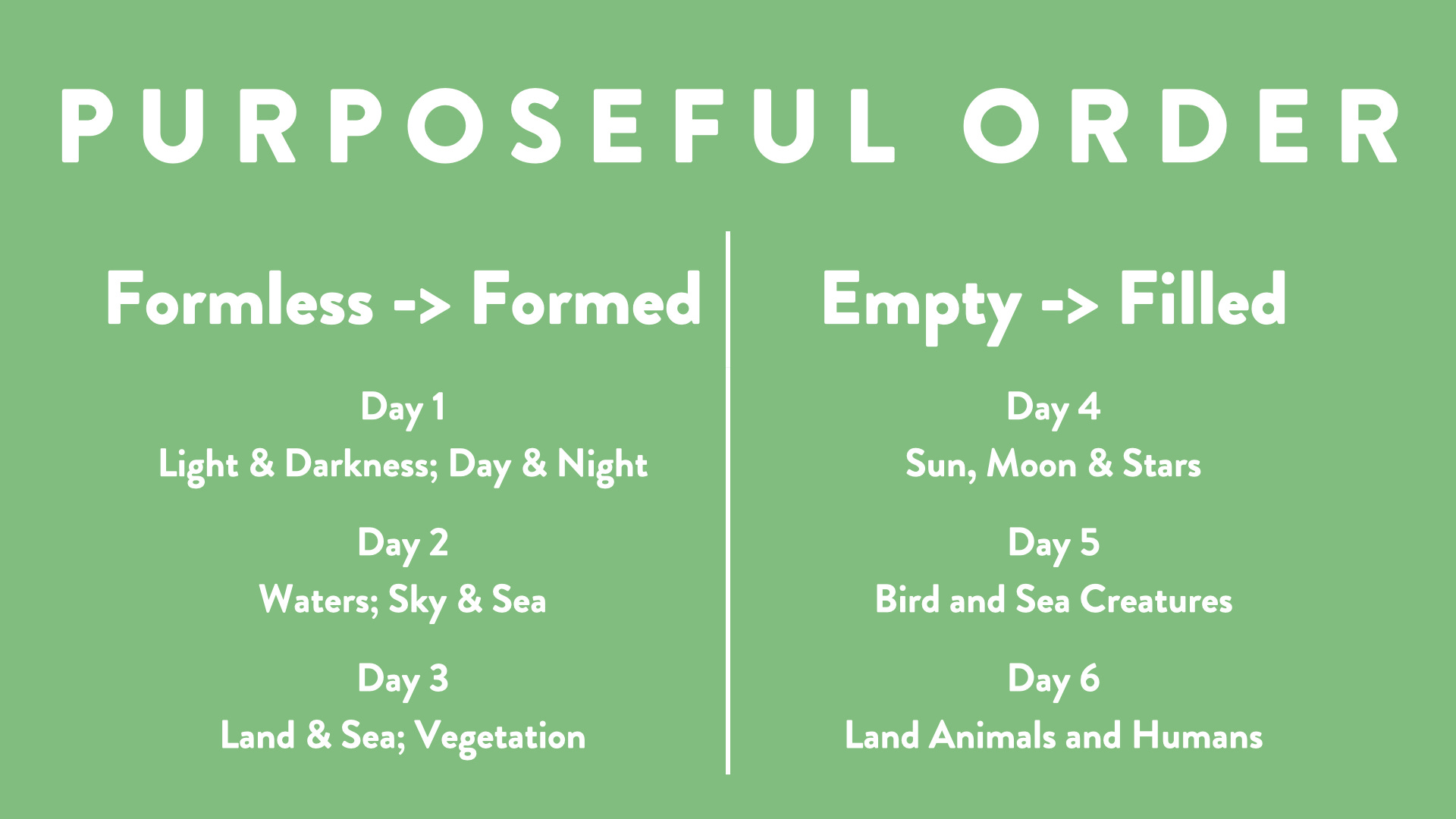
And notice that as God makes, everything he makes is “good”. It is repeated over and over again in the chapter, until he makes humans and reaches the end point of creation where it’s not just good, it is very good! And that word for good means “fit for purpose”. There is a purposeful order in creation.
So here’s our first point: God creates with purposeful order.
This tells us a lot about both God and his world. God is a God who carefully, purposefully, lovingly creates. As opposed to many of the other creation myths that abounded in the Ancient Near East—where the earth is created because the gods are fighting with each other, and killing each other, and forming the earth out of the conquered bodies of their fallen foes—or against the creation myth of a pure evolutionary scientism, where a purposeless bang, spun out a mindless, indifferent universe where nothing has ultimate meaning or value—Genesis 1 tells a very different story. One where a personal and deeply invested God, makes the world with order and purpose and value.
Creation has meaning, life has meaning, YOU have meaning, because a pre-existing, personal and loving God made you!
And because the creation was made with meaning and purpose, there is a way that life is designed. There is a way that life “works” because it is going with the grain of God’s purposeful design.
It reminds me of lot of Lord Business from The Lego Movie. If you don’t know Lord Business, some would say that he is the “villain” in The Lego Movie, but for me, he’s the hero.

Why is he the hero? Because he wants all the Lego to be built according to the instructions. There is a right way that Lego was intended to be built. The design of the designer, the creation of the Creator. And the best way to build, is the build according to that design.
Genesis 1 tells us this truth about creation, that “The universe is not a slap-dash, careless affair” (Christopher Watkin, Biblical Critical Theory).
Which is why Lord Business wants to take all the free-play Lego, break it all apart and only make according to the instructions. And then he superglues the pieces together to keep them all in one spot.
Lord Business is the hero because he recognises that the world has a purposeful order. And he wants to put the world right.
BUT… actually… there is something important that Lord Business has forgotten.
The world is not ONLY about purposeful order, but also about gratuitous beauty.
Gratuitous Beauty
Here’s the full quote from Christopher Watkin: “The universe is not a slap-dash, careless affair, but neither is it a straightjacketed, regimented [superglued] geometry of absolute order.”
Remember this…
Both fulfil the purpose and order of being a balconied window. But only one has gratuitous beauty.
What does “gratuitous” mean? It means over the top. Unnecessary.
We often use it is a bad way. This TV show has gratuitous violence. The violence is unnecessary, over the top, more than what is required to communicate the meaning of the TV show.
But it doesn’t have to be referring to a negative. This window on the right is gratuitously beautiful. The carved stone is unnecessary, over the top, far more than what is required to be a functioning balcony window. And that is what Genesis 1 tells us about creation.
Have a look at how Genesis describes God’s creative acts:
Genesis 1:11 “Then God said, ‘Let the land produce vegetation: seed-bearing plants and trees on the land that bear fruit with seed in it, according to their various kinds.’”
Do we really need bananas AND apples AND kiwi fruit AND oranges? Did you know that there are 60 species of kiwi fruits? 60! That’s gratuitous, unnecessary, over the top!
Genesis 1:16 “God made two great lights – the greater light to govern the day and the lesser light to govern the night. He also made the stars.”
Do you know how many stars there are? The Milky Way alone has 100 billion stars and that’s just one galaxy. Astronomers estimate that there could be up to one septillion stars in the known universe – that’s a one followed by 24 zeros. That’s outrageous, completely unnecessary, gratuitous; but beautiful!
Genesis 1:20 “And God said, ‘Let the water teem with living creatures, and let birds fly above the earth across the vault of the sky.’”
The ocean TEEMS with living creatures. There are potentially up to 2 million species living in the oceans, but 91% of ocean species have yet to be discovered by humans and classified. There are potentially millions of species in our oceans that only God knows about! Isn’t that outrageous?!
Genesis 1:24 “And God said, ‘Let the land produce living creatures according to their kinds.”
There are around 6,400 species of mammals, 12,263 species of reptiles, 8,799 species of amphibians, 11,195 species of birds, and over 1.05 million described species of insects, but once again, many more that we haven’t even described and catalogued yet. No one needs that many species of insects. We would get the point with a dozen species of insects, but there are over 1 million species. It’s gratuitous!
What’s the point?
God did not create the universe just to the functional. He also made it to be gratuitously beautiful. You don’t just have the order imposed by Lord Business, you also have the crazy creativity brought by Emmet, Lucy and the other master builders.

Sometimes you get crazy ideas like the double decker couch, or the platypus, or the blob fish. Ridiculous! But that’s the point.
Watkin again writes:
“God made a riotous universe of fabulous functionality and superabundant systematicity, a perfect marriage between a tie-die bohemian artist and a round-spectacled besuited mathematician.”
Ridiculous AND functional. Bohemian punk AND suited professor. Lord Business AND Emmet. Not just order, but also beauty.
And here’s the cool thing. You and I, we are invited into this creativity, too!
Then God said, ‘Let us make mankind in our image, in our likeness, so that they may rule over the fish in the sea and the birds in the sky, over the livestock and all the wild animals, and over all the creatures that move along the ground.’
Genesis 1:26
We’re going to have much more to say about humans next week, but here’s a sneak peak.
By being made in God’s image and being asked to “rule over” creation, we are being invited into the creational work of God. There is still purposeful order to be pursued. There is still gratuitous beauty to be made. And you and I are God’s plan for that ongoing world of co-creating the world.
Understanding Creation helps us to make sense of our own vocations. We are all called into the work of creating purposeful order and gratuitous beauty in whatever work (and I use that term loosely) we find ourselves in.
Because I don’t just mean our paid “work”, but all the things we do for “play” or pleasure. To the extent that games and art, storytelling and gardening, Lego and origami, puzzles or building sandcastles, to the extent that any of these things engage us in bringing order out of chaos and beauty out of boring utility; these also contribute to our participation in the co-creating work of God.
But… once again… much more about humans next week! So stay tuned.
Climactic Rest
As we consider Genesis chapter 1 and understand who this God is who made our world to work (as John and Kim Walton said), all of it is meant to inspire us, to motivate us, to give meaning and purpose and value to our lives—both vocational lives and in our leisure lives.
But for some, it might just sound exhausting. The application for today' is to work more?! Seriously?!
For those of us exhausted by work, for whom the pressure of busyness, or overachievement, or perfectionism has made life, not joyful and inspired, but weary and heavy-laden, I want to finish on this third point.
The end of God’s creative work in Genesis 1 is not creative effort, but rest. Once again, I am going to have much more to say about this next week when we focus in on the creation and purpose of humanity with the ‘white’ colour of life. But it is significant that the work of God in creation moved towards its climax in REST.
Christopher Watkin once again:
“The climax of work is not a promotion, a raise, or recognition, but rest… For God, the rest itself is the thing: neither the rest of laziness nor the rest of increasing productivity, but the rest of enjoyment.”
Not rest, just so you can buck up the next day and keep going. Not rest so you can work hard again. Genuine, stopping, final, enjoyable, rest.
This is a pathway, the trajectory, that Creation is running towards.
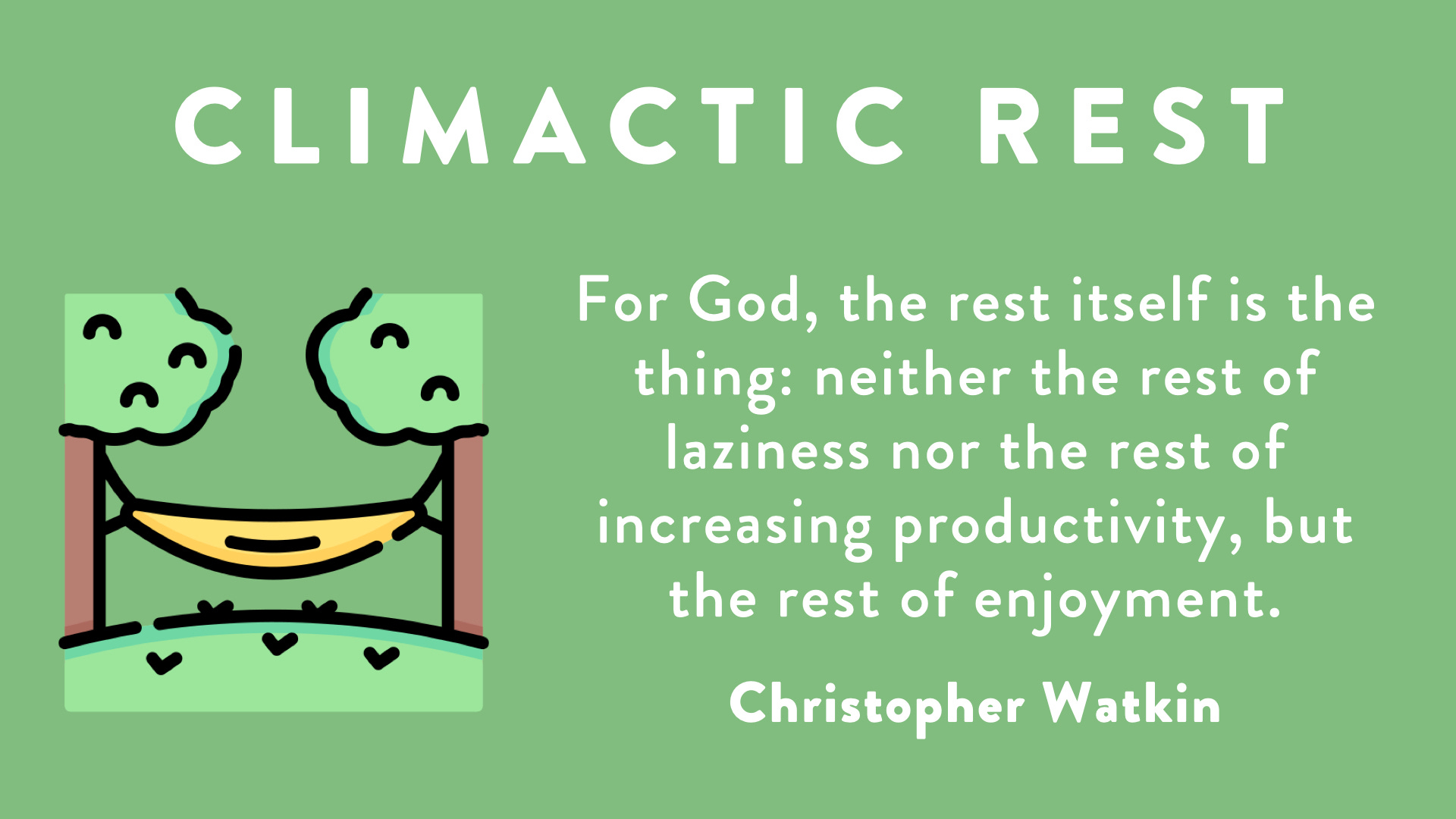
CREATION has a purposeful order, infused necessarily with a gratuitous beauty, that is pointed towards climactic rest.
Which sounds wonderful, doesn’t it?! Isn’t this the way we wish the world was? Doesn’t this resonate with your soul? Don’t you, in your quiet moments, dream about the peace that comes from order, beauty and rest? Or is that just me?
This is the Christian view of CREATION. How it was made, how it is intended to function, how we were designed by our designer to live.
Why don’t we find it that way? Why isn’t it that way now? Ahh…! Good question. For that, you’re going to need to come back over the next four weeks as we continue in this series of the colours of life.
Because we are only just at the beginning.
Andrew Reid in his commentary on Genesis writes, “Genesis is a start waiting for a finish, a beginning waiting for an end.”
And if you want to know more about that end, then we’ll see you here next week!