


If, like me, you enjoy a good, juicy morsel of religious data, the most delicious meals are regularly served up by Ryan Burge over at Graphs About Religion. Burge’s posts are frequently fascinating, detailing the intricacies of the American religious landscape.
As an Australian reader, Burge acts as a tour guide to the familiar, yet foreign land across the Pacific. The US holds enormous cultural influence in Australia in both secular and Christian spheres. The media we consume, the news we watch, and the influencers we follow are all saturated with American content.
However, obvious to any Australian, regardless of this impact, is that we are not American. We know the cultural distinctions. We are practised at translating US-centric content into our native dialect. And, alongside our own unique multicultural experience, we continue to have strong influence from Britain that expands our understanding of both Christian and post-Christian societies.
Judging by the surprised tone in Burge’s most recent post, it is less obvious to our American friends how distinctive Australians are, especially when it comes to matters of religion.

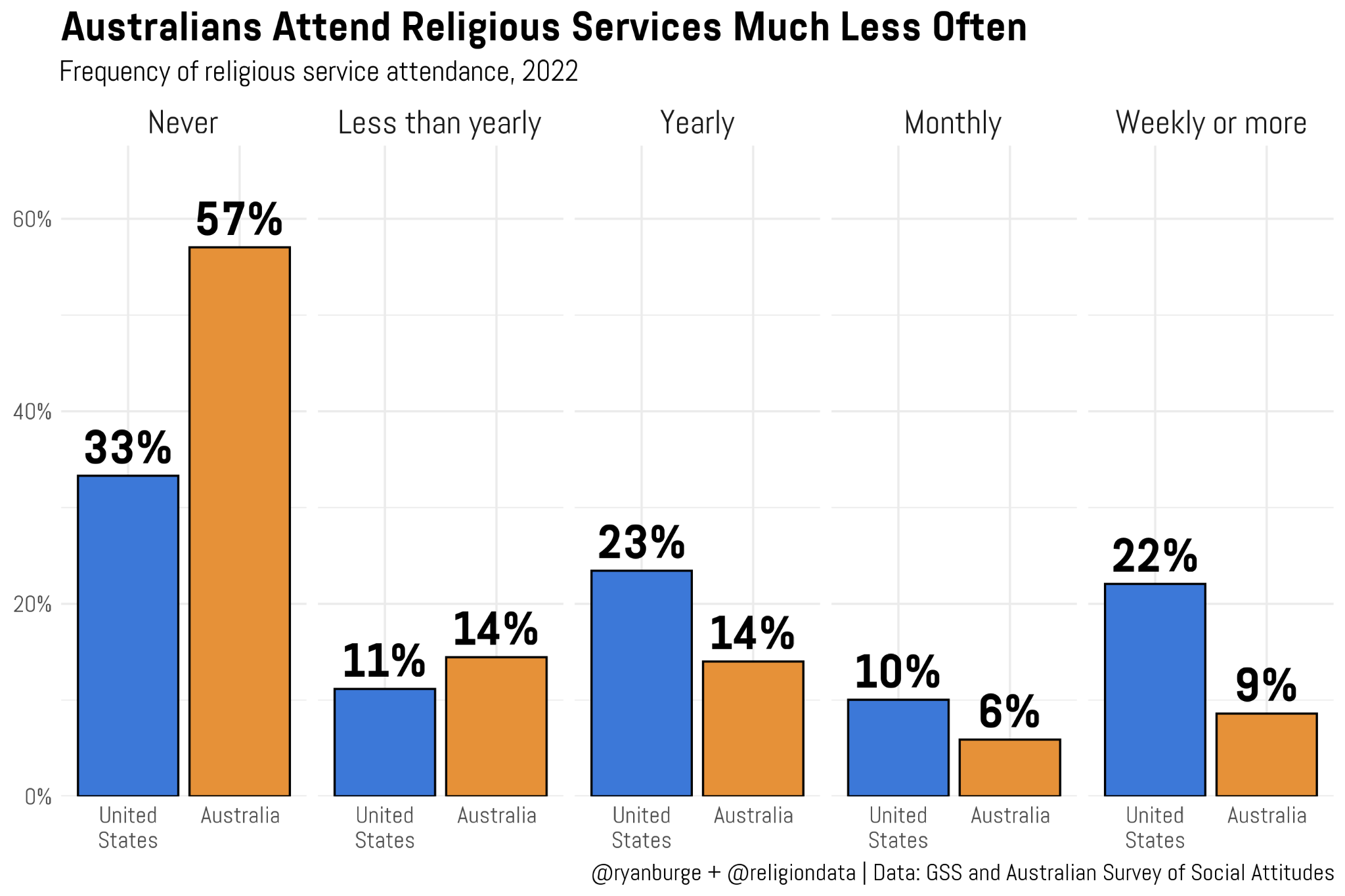
Looking at comparative data on religious service attendance, only 29% of Australians darken the door annually or more, and only 9% weekly. Whereas the majority of Americans (55%) have been to church in a given year, 22% of whom are weekly attenders.
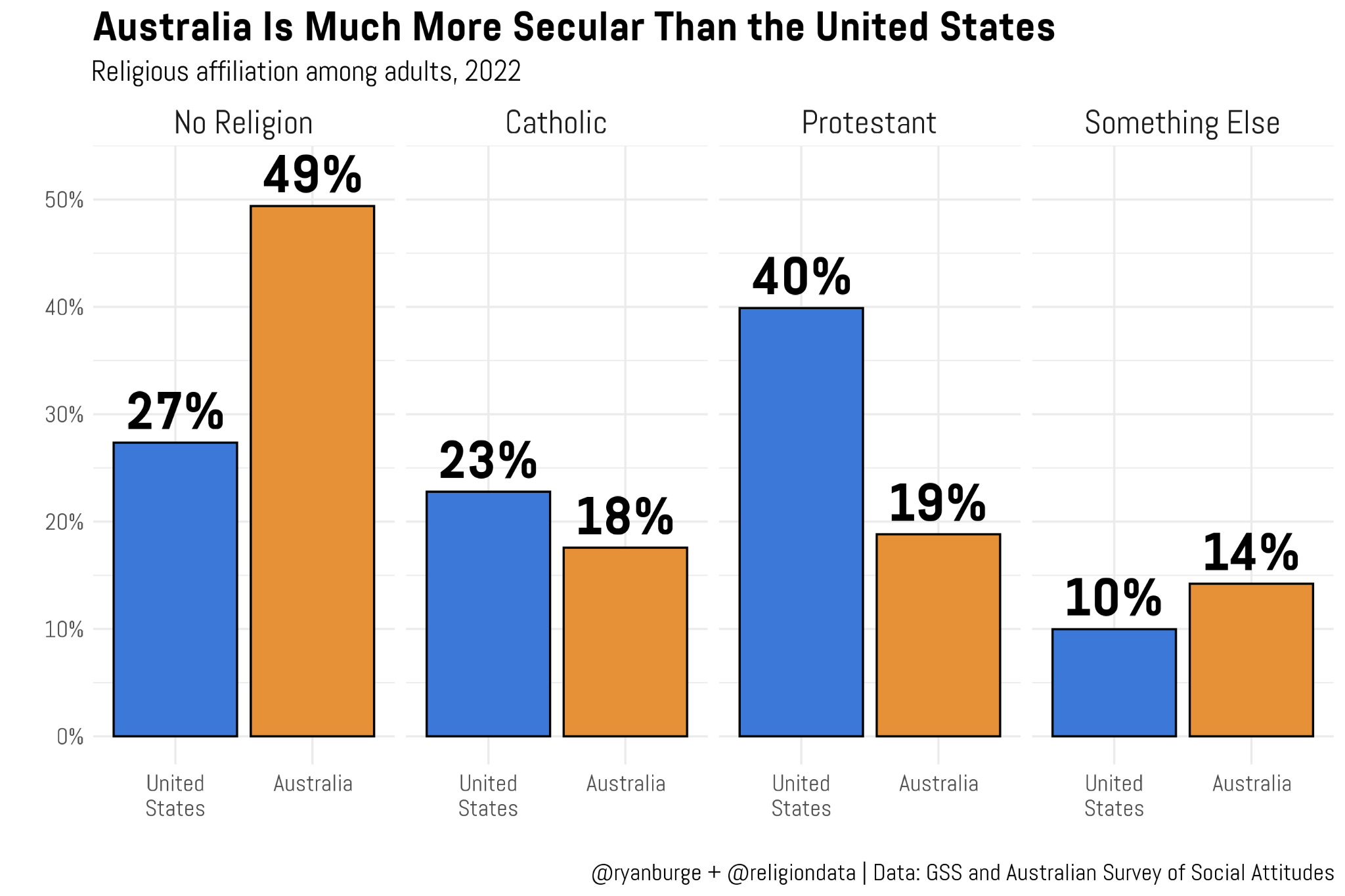
There’s also data on religious affiliation, with Australia having a significantly higher proportion in the ‘No Religion’ category, and higher (though by a lower margin) in ‘Something Else’. Burge notes,
“About half of Aussies indicated no religious affiliation. That’s almost twice the rate of the nones in the U.S at 27%. So, where does the American sample “find” those 22 points? It’s the Protestant category. Americans are twice as likely to identify as Protestant compared to Australians, 40% vs 19%.”
As a church minister in Australia, none of these statistics are all that surprising. But it is helpful to have the religious distinctions between our two countries noted and reported on by a U.S. demographer.
There are unique challenges to discipleship, mission and ministry in Australia. Burge again:
“The share of atheists in America (not nones, just atheists) is around 5%. Only 6% of young Australians are Protestant.”
As a Children’s Pastor specifically, I spend a lot of time wondering about how we form faith in young people when <15% of the people they will interact with in any given week share their most foundational commitments, values, beliefs and practices in such a way that it would prioritise monthly (6%)—let alone weekly (9%)—church attendance. The plausibility structures of Christian faith are far weaker in Australia than in the US, and the trajectory of faith in the country is, at least humanly speaking, sobering.
“It wouldn’t surprise me at all if Australia is two-thirds unaffiliated in 30 years, with only 20% of the population worshipping at least once a year. I think it’s fair to say the overall religiosity of Australia is much closer to many of their European cousins than the United States.”
What ought our response be to this information? Three quick things:
I encourage you to read the full article for yourself to be better informed on the state of religious life in Australia.
For my US and international readers, I would love to hear your response to this data. What would you have thought the religious landscape of Australia was compared to your home country? About the same? Slightly less religious? Much less religious? What surprises you about the state of religious life down under?
For everyone, please continue to pray for ongoing opportunities for mission and discipleship across all ages in Australia.
Being significantly ‘post-Christian’ presents several opportunities alongside the concerns. As a previous Prime Minister famously said, we are “alert but not alarmed”. Our hope is in Christ and his Kingdom, not a Christianised culture. And yet we long for revival so that our fellow Australians may share in the blessing of knowing, and being known, by Christ Jesus and the joy of living under his lordship.